Stretch Ceiling in UAE: Backlit, Glossy, Mirror, Matte, and Custom Designs
Most of us agree that the ceiling can completely change how a space feels.
It might be a smooth, perfectly flat surface that almost disappears, a glossy finish that reflects the room, or a luminous ceiling that looks like one enormous, softly glowing light.
That’s the interesting thing about having a stretch ceiling in UAE.
They aren’t limited to hiding an imperfect ceiling. They can become an important part of the interior design, integrating lighting, creating visual effects, and changing how a room feels.
A stretch ceiling is a ceiling system made from a flexible membrane or fabric secured to perimeter profiles.
Depending on the product, finish, and installation method, the surface can be matte, satin, glossy, translucent, printed, reflective, or shaped into customized forms.
In the UAE, stretch ceilings are used in villas, apartments, hotels, restaurants, offices, retail spaces, and other interiors where appearance and lighting need to work together.
They can conceal existing ceiling imperfections, create backlit surfaces, and accommodate selected architectural and decorative features.
However, the right system depends on the overall villa lighting design the property owner choses.
Material properties, available ceiling depth, lighting distribution, electrical coordination, fire-performance documentation, and access for maintenance all affect the final result.
STRETCH CEILING MATERIAL
Before choosing a finish, it helps to understand what actually makes a stretch ceiling for luxury villas work.
Although the completed surface may look simple, its performance depends on the membrane, the perimeter fixing system, the supporting structure, and the way other building services are integrated.
Different systems can look similar once installed while having different material characteristics and lighting installation requirements.
What Is a Stretch Ceiling?
A stretch ceiling uses a flexible sheet or membrane held under tension by profiles fixed around the perimeter of the room.
The resulting surface can provide a smooth finish beneath the existing ceiling or be designed at a specific height to accommodate lighting and other equipment.
Some systems use PVC film that is softened with controlled heat during installation.
Others use textile-based membranes with different fitting methods.
The exact process depends on the manufacturer’s system, so installation methods should not be assumed to be interchangeable.
Many homeowners start to think about stretch ceilings as they contemplating staircase lighting design or other forms of lighting design.
PVC Film and Textile Membranes
PVC-based stretch ceilings are available in a wide range of finishes, colors, and specialist versions.
Depending on the product, the membrane may be opaque, translucent, printed, reflective, or designed for integration with particular lighting systems.
Textile-based systems differ in their construction, installation method, and available finishes.
Some are designed for cold installation, while other systems use different tensioning techniques and compatible profiles.
The choice should be based on the specific product’s technical documentation rather than a general assumption that all stretch ceilings behave the same way.
The Role of Perimeter Profiles
The profiles secure the membrane and establish the finished ceiling’s shape.
Depending on the system, the profiles may be visible or concealed and may support straight, curved, or more complex designs.
The selection of a profile also affects perimeter detailing, transitions between ceiling levels, and how the membrane can be accessed later.
For custom projects, the profile arrangement should be coordinated with the room dimensions, ceiling geometry, lighting, and other technical elements before installation begins.
What to Check in the Technical Specification?
A reliable specification should identify the exact membrane or fabric, its finish, color, fixing system, and relevant performance documentation.
The project team should also verify the required fire classification, environmental declarations, cleaning instructions, warranty conditions, and installation requirements for the selected product.
Claims about durability, recyclability, moisture resistance, and indoor emissions should be supported by documentation for the actual system being supplied.
STRETCH CEILING DESIGN (MATTE, SATIN, GLOSSY, AND CUSTOM FINISHES)
One of the biggest advantages of stretch ceilings in UAE is the choice of surface finishes.
The membrane can act as a quiet architectural background, reflect the room, or become a feature in its own right.
The best choice depends on the interior concept, ceiling height, lighting arrangement, and the visual effect you want to achieve.
Matte Stretch Ceiling in UAE
Matte finishes offer a soft appearance with minimal specular reflection that can fit different luxury spaces in UAE.
They are often chosen when the ceiling should feel understated and complement the walls, flooring, and furniture without attracting too much attention.
This makes matte stretch ceilings suitable for bedrooms, living rooms, corridors, and many contemporary villa interiors.
A matte surface can also be useful where reflections from decorative fixtures or windows would be distracting.
However, the final appearance still depends on the membrane’s color, texture, installation quality, and the lighting in the room.
Satin Stretch Ceiling in UAE
Satin finishes sit between matte and high-gloss surfaces.
They provide a subtle sheen without producing the pronounced mirror-like reflections associated with highly reflective membranes.
This balance can work well in dining areas, entrances, lounges, and interiors where the designer wants a little more visual depth without turning the ceiling into a dominant feature.
The apparent sheen may change depending on viewing angle and light direction, so reviewing a sample under the proposed lighting is worthwhile.
Glossy Stretch Ceiling in UAE
Glossy membranes reflect more of the surrounding room than matte finishes.
Depending on the color and reflectivity, they can create the impression of greater depth and visually expand the ceiling plane.
They are sometimes used in entrance areas, showrooms, feature rooms, and other interiors where reflection is an intentional part of the design.
However, gloss can also reveal clutter, strong light sources, and visual inconsistencies.
A successful design considers what the ceiling will reflect, not just the appearance of the membrane itself.
Colored and Custom Finishes
Stretch ceiling systems may be available in many colors, textures, and specialist finishes.
Custom options can coordinate the ceiling with the interior palette or establish a distinctive visual feature.
For a villa, this might mean a colored ceiling within a reception area. A restaurant might use a particular finish to reinforce its interior concept, while a retail space could use a branded surface.
The availability of specific colors, finishes, widths, and shapes depends on the selected manufacturer.
Samples and technical specifications should be approved before production.
TRANSLUCENT STRETCH CEILING
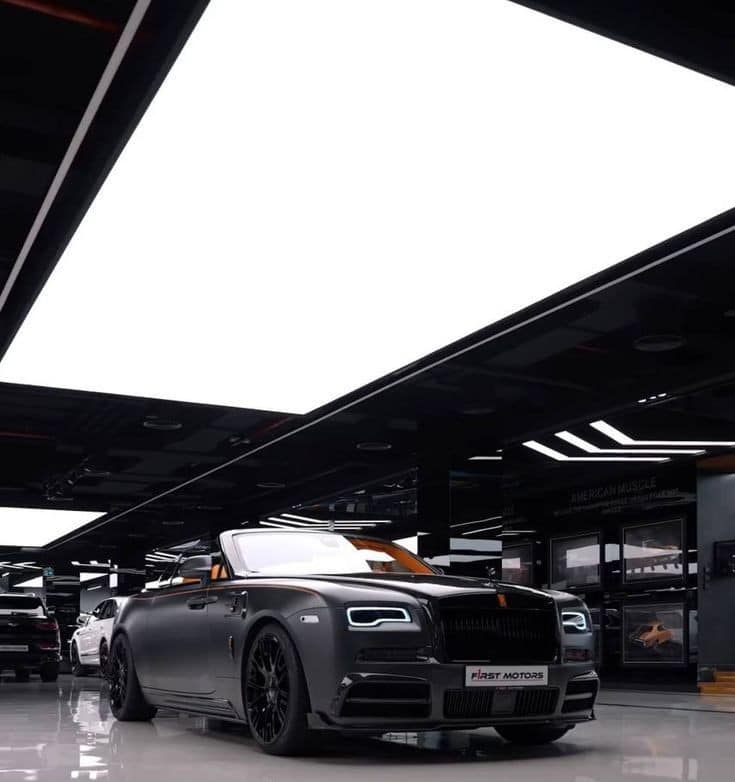
A translucent stretch ceiling allows light from behind the membrane to pass through and spread across its surface.
Instead of seeing a conventional light fixture, the viewer sees a luminous ceiling plane.
This is one of the most distinctive applications of stretch ceiling technology, but creating a convincing result takes careful planning of the membrane and lighting system together.
How Backlit Stretch Ceilings Work?
A translucent membrane is installed over a space containing a suitable lighting arrangement, commonly using LED luminaires or modules.
The membrane diffuses the light so that the finished surface appears illuminated.
The result depends on the membrane’s light transmission, the distance between the light sources and the membrane, the layout of the LEDs, and the reflective properties of the surrounding cavity.
A membrane alone does not guarantee an even luminous surface. The lighting system must be designed to suit the selected product and the size and shape of the installation.
Creating Uniform Illumination
One of the main challenges is preventing visible bright spots, stripes, and shadows from appearing through the membrane.
LED spacing, optical distribution, cavity depth, reflective surfaces, and output all influence uniformity.
The requirements of a small, illuminated feature panel may differ substantially from those of a ceiling that extends across a large living room.
A test panel using the actual membrane and lighting arrangement can help reveal problems before the full ceiling is produced.
Choosing the Color of the Light
A backlit ceiling can use white light with different color characteristics or a compatible color-changing system where required.
Warm-white light may help create a relaxed atmosphere in a residential space, while a neutral appearance may suit certain commercial or contemporary interiors.
Color-changing systems can support more dynamic concepts but should be selected according to the purpose of space.
The designer should also consider how the luminous ceiling interacts with other lights.
If the entire ceiling is bright, separate accent lighting may need to be reduced or positioned carefully to preserve the visual hierarchy.
Where Backlit Ceilings Work Best?
Backlit stretch ceilings can be used in villa entrances, living areas, kitchens, hotel lobbies, restaurants, reception areas, retail displays, and selected commercial interiors.
A luminous ceiling can help create the impression of a larger, brighter surface.
It may also serve as a major design feature where a conventional arrangement of visible downlights is not the desired look.
The final specification should address dimming, driver access, energy consumption, heat management, and maintenance as well as the appearance of the light.
STRETCH CEILING LIGHTING WITH DOWNLIGHTS AND LINEAR LIGHTS
Not every stretch ceiling needs to glow across its entire surface.
Many designs combine an opaque membrane with conventional or architectural lighting, including recessed downlights, linear LED profiles, magnetic tracks, decorative pendants, and concealed cove lighting.
The important point is that the ceiling and the lighting need to be designed as a single coordinated system.
Recessed Downlights and Spotlights
Downlights can provide general illumination, while adjustable spotlights can highlight artwork, joinery, or architectural features.
Installation usually requires a suitable mounting platform or support arrangement, along with appropriate detailing around any membrane openings.
The exact reinforcement and mounting method should follow the ceiling and luminaire manufacturers’ instructions.
Thermal compatibility is important. The fixture, driver, clearance, and membrane must be suitable for use together so that the system does not suffer from overheating or damage around cut-outs.
Linear LED Lighting
Linear lighting can create clean architectural lines across a ceiling or define the boundary between different areas of a room.
Depending on the design, it may be surface-mounted, recessed into a compatible profile, or integrated into a custom ceiling detail.
The chosen solution should be checked for alignment, visible joints, light distribution, and the required space for electrical components.
Longer runs may need particular attention to power distribution, driver positioning, and consistency of brightness.
Concealed Cove Lighting
Cove lighting places the light source within a recess so that the light illuminates the ceiling or adjacent surface indirectly.
It can create a soft perimeter glow and make ceiling transitions appear more subtle.
The result depends on the location of the cove, the geometry, the lighting equipment, and the reflectance of the illuminated surface.
Drivers and other components should remain accessible where required, even when the design aims to conceal them from view.
Controls and Dimming
A stretch ceiling lighting system may include dimming, separate control zones, or compatible smart lighting controls.
These features should be planned before installation because they affect the wiring, equipment, and control configuration.
The luminaire, driver, dimmer, and control system must be compatible with one another. Otherwise, users may experience flickering, limited dimming range, or unreliable operation.
For a villa or hospitality project, the controls should also be intuitive and easy to maintain.
BARRISOL STRETCH CEILING
Barrisol is an established manufacturer of stretch ceiling and wall systems, with product ranges that include translucent, acoustic, printed, decorative, and specialist lighting solutions.
The name is often used in discussions about stretch ceilings, but it is important to distinguish the Barrisol brand from the broader category of tensioned ceiling systems.
Product Options and Specialized Finishes
Barrisol’s published product information describes multiple ceiling systems and finishes, including matte, satin, lacquered, translucent, printed, and acoustic versions.
Its lighting range includes translucent membranes designed to diffuse light from a source behind the ceiling.
Depending on the specific product, the membrane may also support printed designs, colored light, or other decorative effects.
Not every feature is available in every membrane. The designer should check the exact product reference and technical documents before specifying a solution.
Integrating Technical Elements
Stretch ceiling systems may be designed around lighting, ventilation elements, sprinklers, detectors, access openings, and other building services.
The integration details vary according to the component and the ceiling system.
Some openings may need dedicated frames or reinforcement, while other elements require particular profiles or installation clearances.
The layout should be coordinated before the membrane is fitted so that required components can be positioned correctly and remain accessible for inspection or replacement.
Fire Classification and Product Documentation
Fire-performance claims must be checked against the exact product, finish, and relevant classification documentation.
Barrisol’s published information lists different fire classifications depending on the product. These should not be generalized to all stretch ceiling membranes or all installation conditions.
For projects in Dubai and Abu Dhabi, ask the supplier to provide the relevant certificate and confirm its acceptance under the project’s applicable building requirements.
Warranty and Authorized Installation
Manufacturer warranties depend on the product and their stated terms and conditions.
The project team should confirm who provides the warranty, what it covers, and what installation or maintenance conditions apply.
Where a project specifies a branded system, it is also worth checking that the supplier can document the product’s origin and provide appropriate installation support.
MIRROR STRETCH CEILING
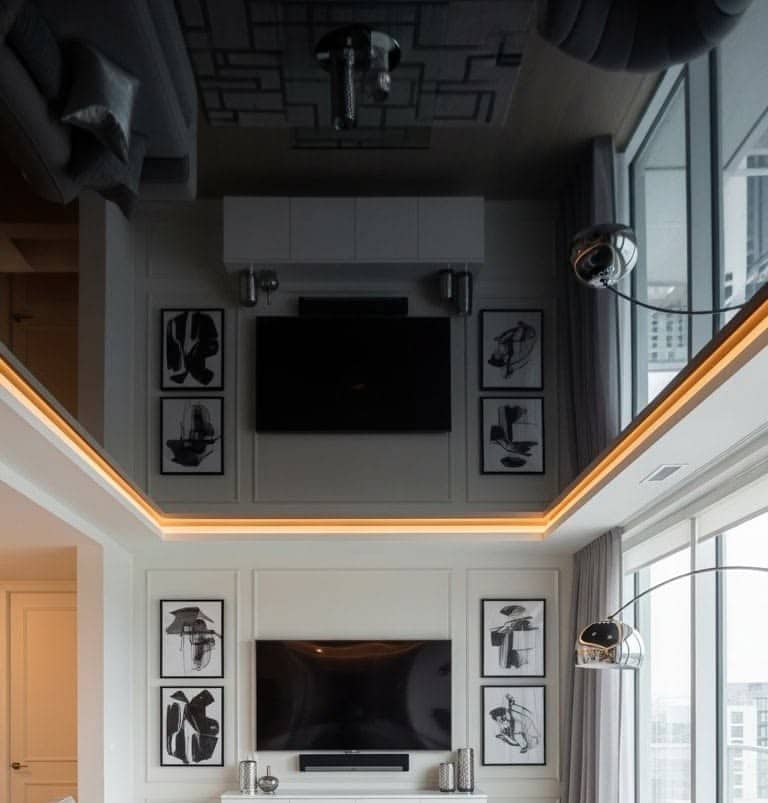
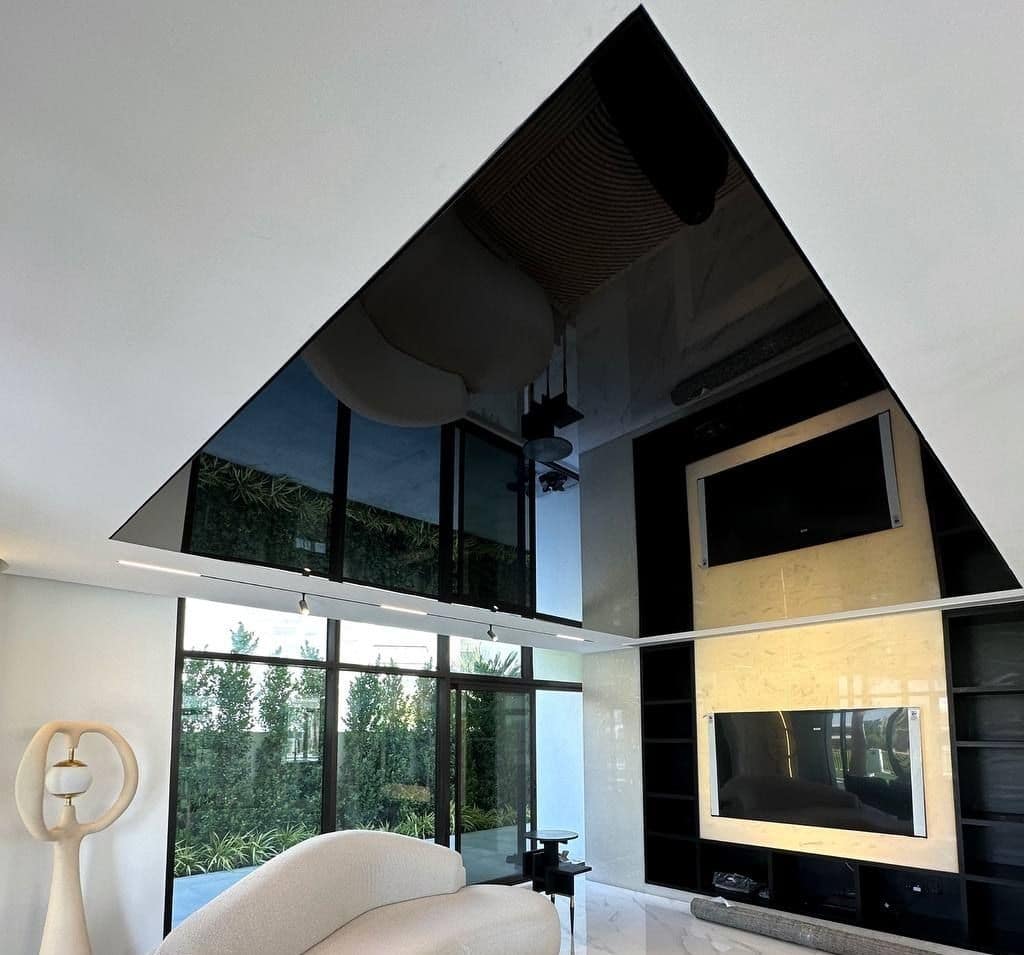
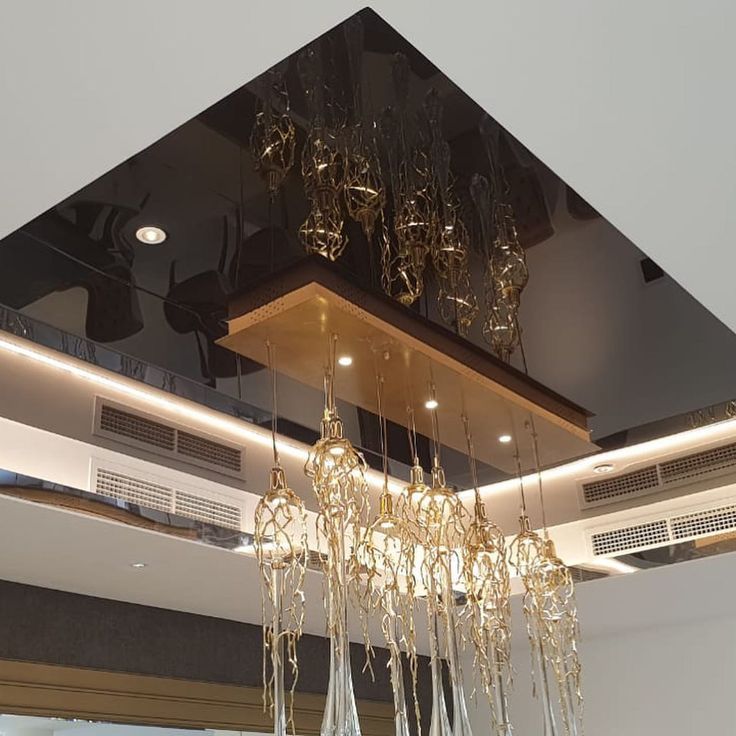
A mirror-effect stretch ceiling uses a highly reflective surface to reflect the room below.
It can make selected areas feel visually more open and turn the ceiling into a distinctive decorative feature.
Although it may resemble a conventional mirror from a distance, its actual reflection depends on the membrane, finish, tension, installation, and viewing conditions.
Where Mirror Finishes Can Work Well?
Reflective ceilings may suit entrance areas, selected living spaces, boutique interiors, retail displays, and hospitality environments where the design intentionally uses reflection.
The finish can visually extend the room by reflecting floor patterns, furniture, decorative fixtures, and surrounding architecture.
It is particularly important to consider the objects directly beneath the ceiling. Everything that is reflected becomes part of the visual composition.
Managing Reflections and Lighting
A reflective ceiling can also reflect visible light sources, windows, and bright surfaces.
The lighting should therefore be reviewed from several viewpoints.
A fixture that looks comfortable when viewed directly may become visually distracting when reflected overhead.
Recessed, shielded, or carefully positioned luminaires may work better than exposed bright sources in some situations.
Before committing to a large installation, review a real sample under the proposed lighting. This helps establish whether the reflective effect suits the room.
Installation Quality Matters
The finished appearance depends on the selected product and installation.
The supporting profiles, perimeter details, membrane condition, and tensioning method all contribute to the visual result.
A mirror-effect finish may make irregularities or alignment problems more noticeable than a matte surface would.
Accurate measurement and suitable installation practices are therefore particularly important.
REFLECTIVE STRETCH CEILING
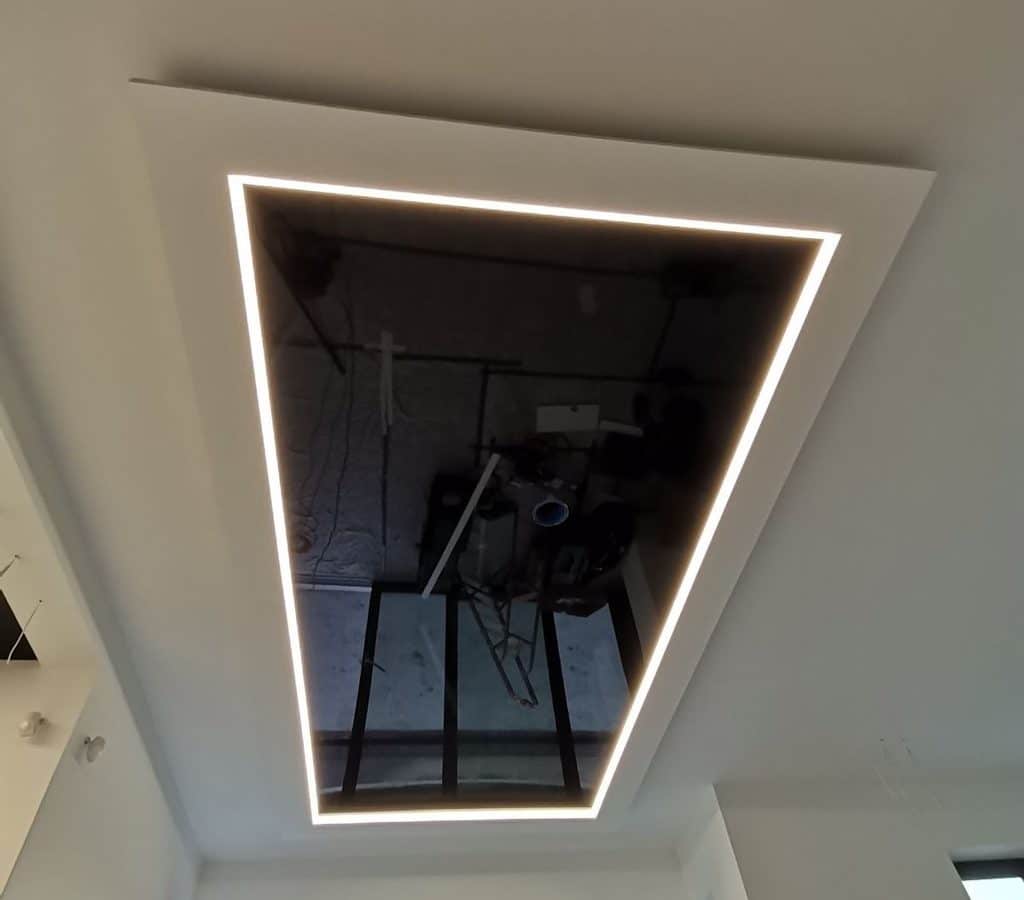
The terms reflective stretch ceiling and mirror stretch ceiling overlap, but they do not necessarily describe exactly the same visual effect.
A glossy membrane may produce broad reflections and a noticeable sheen without providing the same mirror-like appearance as a highly reflective specialty finish.
Understanding Gloss and Mirror-Like Effects
Gloss describes a surface with a pronounced specular reflection.
The reflected image may be soft or distorted compared with a conventional flat mirror, depending on the membrane and its surface characteristics.
Mirror-effect products aim for a stronger reflective appearance.
The actual result should be verified using the manufacturer’s specifications and, ideally, a physical sample.
Reflectivity and Room Proportions
Reflective ceilings can make a room appear more open by extending visual elements upward.
However, the result depends on ceiling height, room dimensions, furnishings, and the amount of visual information reflected.
In some spaces, reflection adds depth and interest.
In others, it can make the ceiling too visually active, especially when the room contains many decorative fixtures or strong patterns.
A reflective finish should therefore be chosen because it supports the interior concept, not simply because it promises to make the room look larger.
Cleaning and Ongoing Care
Cleaning procedures depend on the membrane’s material and finish. Abrasive materials, unsuitable chemicals, or excessive pressure may damage some surfaces.
The installer should provide the manufacturer’s cleaning guidance. Reflective finishes may need particular care because marks or surface damage can be more noticeable than on a matte ceiling.
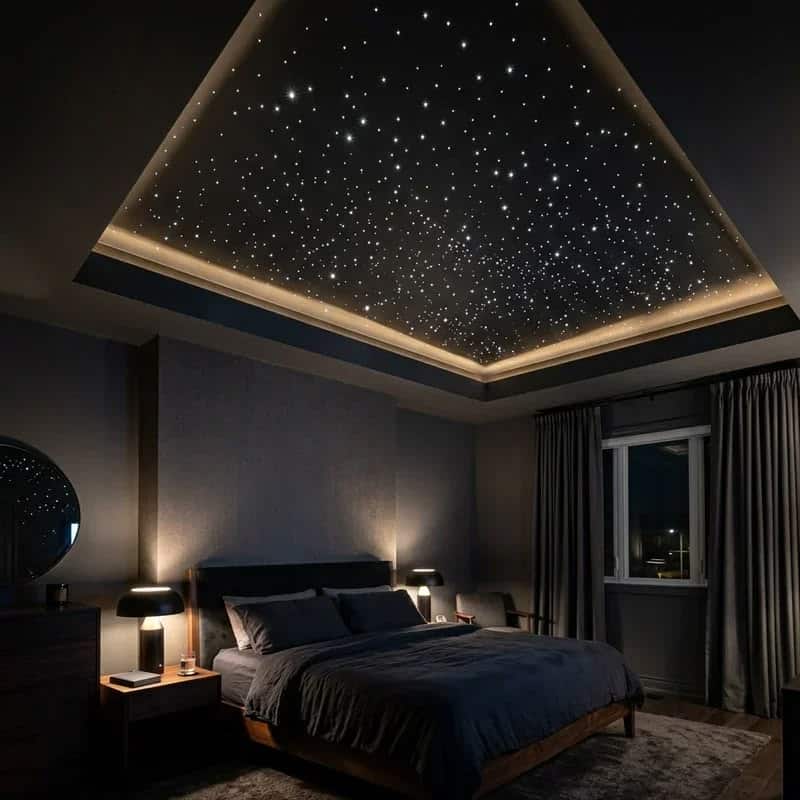
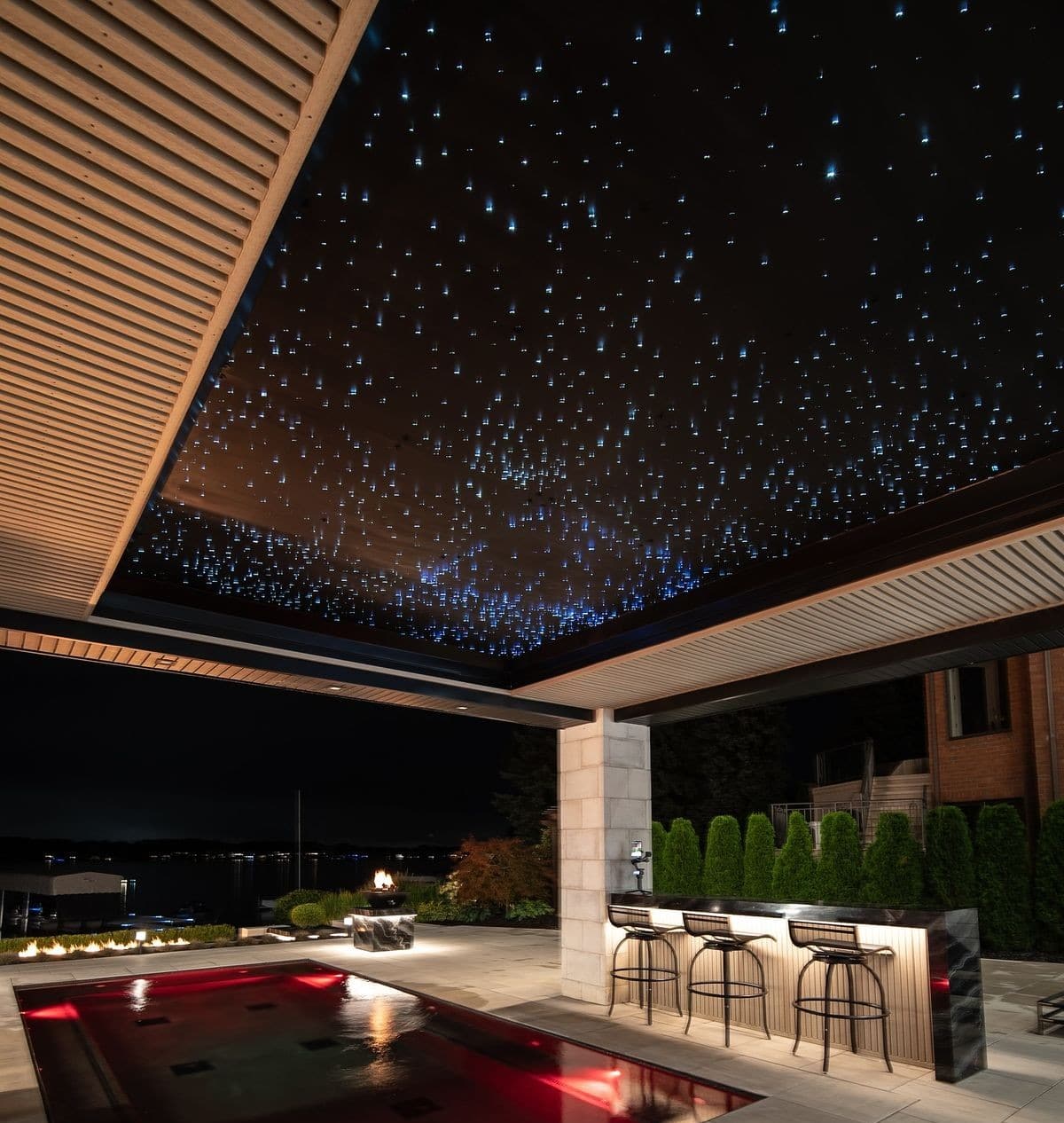
STRETCH CEILING SKY (WITH STAR CEILING EFFECTS)
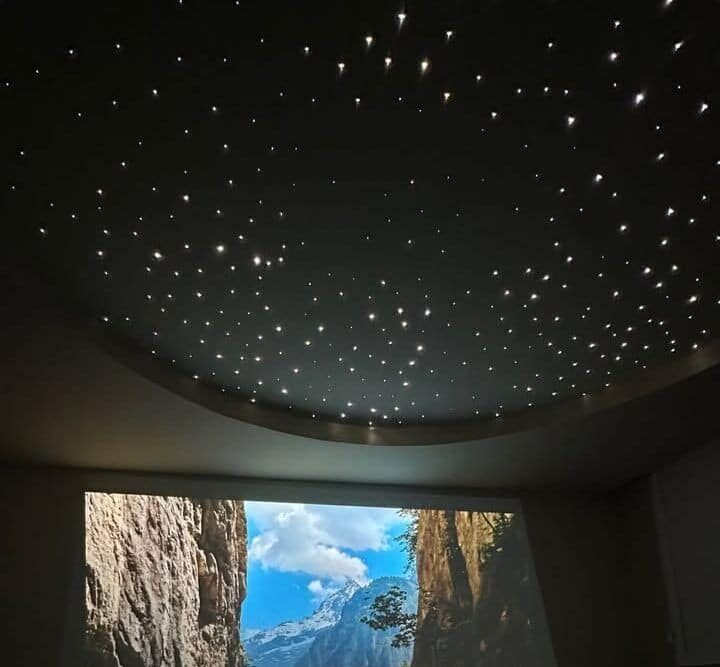
A sky-themed stretch ceiling can create a distinctive visual feature in a bedroom, home theater, hospitality space, or themed interior.
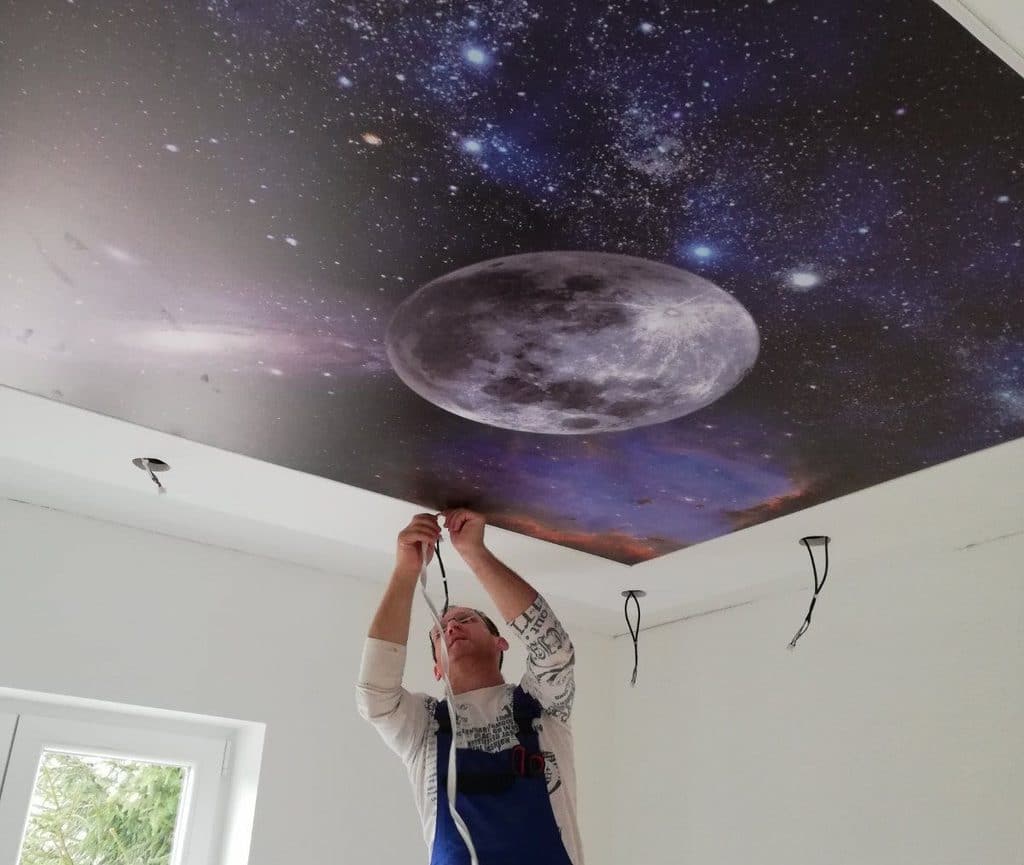
There are two common approaches: printing a sky image onto a compatible membrane or creating a starry-sky effect using a suitable lighting system.
Printed Sky Ceilings
A printed membrane can reproduce clouds, blue skies, abstract patterns, artistic imagery, or a customized design.
The image should be prepared at a resolution and color profile appropriate to the finished dimensions. The designer should also consider how the image will align with the room’s geometry and whether seams or joins will affect the composition.
If the ceiling is backlit, the print and membrane must be suitable for that application.
Backlighting can change the apparent brightness and colors of the image, so a sample or proof under the intended lighting conditions is useful.
Starry-Sky Ceilings
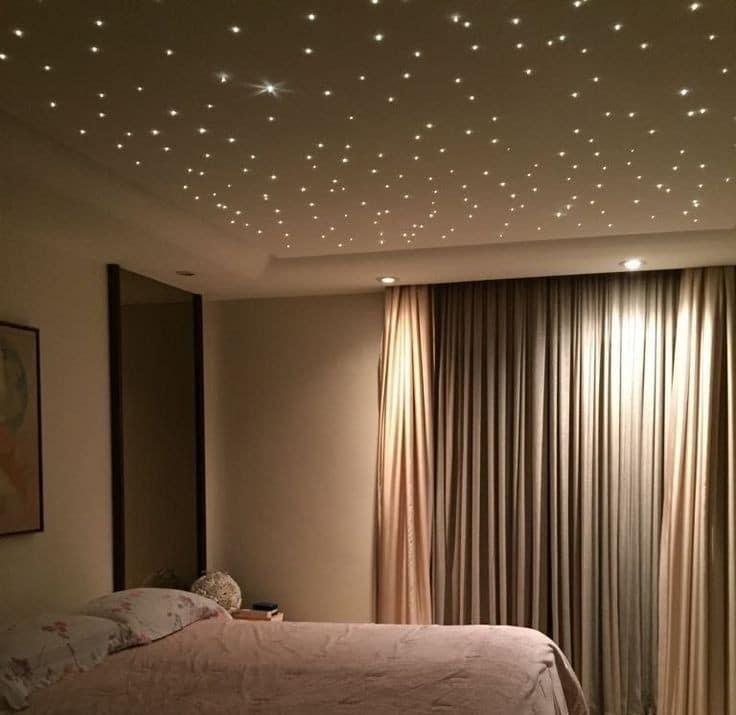
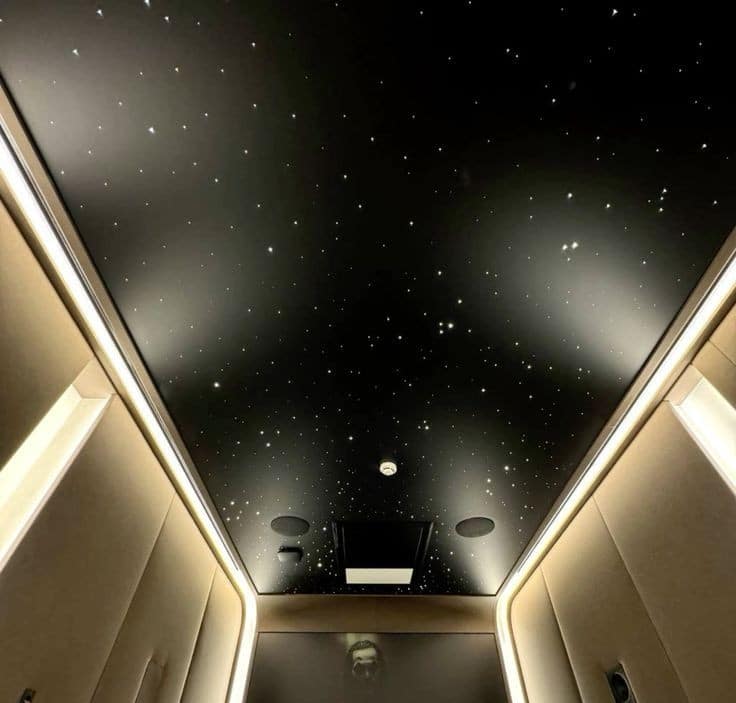
A starry-sky effect commonly uses fiber-optic points or a compatible lighting system to create the appearance of small, illuminated stars.
The designer can vary the number and distribution of points to create a subtle night sky or a more concentrated pattern. Dimming and compatible control equipment may allow the effect to be adjusted to suit the room.
The layout should be coordinated with other ceiling fixtures.
Downlights, smoke detectors, sprinklers, and access points may interrupt the intended pattern if their positions are not considered early.
Choosing the Right Space
Printed and starry-sky ceilings can work well in home theaters, children’s bedrooms, hotel feature rooms, entertainment spaces, and selected residential interiors.
The design should suit the room’s purpose.
A highly decorative sky effect may be appropriate for an entertainment space but unnecessary in a room intended to have a quiet, understated appearance.
STRETCH CEILING SUPPLIER IN UAE
A supplier serving the UAE may handle residential, commercial, retail, and hospitality applications, but the requirements of these projects can vary significantly.
The selection should reflect the location, the interior design, the technical requirements, and the installation conditions.
Residential Villas and Apartments
For a villa, the priority may be a smooth finish, concealed lighting, a reflective entrance ceiling, or a custom decorative feature.
The supplier should understand how the chosen membrane works with the ceiling height, lighting arrangement, and other interior finishes.
If the project includes several different room types, it may be appropriate to combine matte, gloss, translucent, and custom finishes rather than using one finish everywhere.
Hotels, Restaurants, and Retail Interiors
Hospitality and retail projects may need larger illuminated surfaces, printed graphics, acoustic options, or ceilings with more complex geometry.
The technical package should establish fixture positions, lighting uniformity, control requirements, fire-performance documentation, and maintenance access.
The supplier and installer should coordinate with the wider design and construction team.
Confirm Delivery and Installation Capabilities
Ask about measurement, manufacturing lead times, installation sequencing, and the team’s ability to coordinate with other trades.
Projects involving custom printing, special profiles, backlighting, or large membrane surfaces need enough time for the relevant design and technical checks.
A realistic program should include product approval, site preparation, installation, testing, and handover rather than assuming every design can be installed at the same speed.
PROFESSIONAL STRETCH CEILING COMPANY IN UAE
A stretch ceiling is a complete system, not just a sheet of material.
The quality of the result depends on the membrane, profiles, supports, lighting integration, measurement, installation, and finishing details.
This makes the installation team’s experience an important part of the purchasing decision.
Evaluate Technical Knowledge
A professional company should be able to explain how the selected membrane will be installed and how lighting, ventilation, detectors, and other required elements will be accommodated.
It should also know which details require approval from the lighting designer, electrician, or other relevant professionals.
Electrical modifications and other regulated work must be handled by appropriately qualified personnel.
Check Fire and Performance Documentation
Request technical documents for the exact product and finish being proposed.
These may cover fire classification, indoor emissions, cleaning instructions, warranty conditions, and other relevant characteristics.
A general brochure may not prove that every finish in a product family has the same classification. The evidence should match the actual product being supplied.
Confirm Warranty and Maintenance Terms
Ask who provides the warranty, what it covers, and whether any conditions apply to installation or maintenance.
It is also important to understand how the membrane and any integrated equipment can be accessed for future servicing.
Some systems are designed for removal and refitting, but this capability and its limitations must be confirmed for the particular product.
Review Coordination and Handover
The installer should follow the approved drawings and coordinate with the relevant project trades.
Changes to fixture locations, membrane details, or other components should be reviewed before they affect the finished ceiling.
A clear handover should identify the materials installed, provide the necessary product information, and explain any maintenance requirements.
STRETCH CEILING DUBAI (INSTALLATION AND PROJECT PLANNING)
A stretch ceiling should be planned around the actual room, the intended finish, and any lighting or technical elements that need to be incorporated.
The process is generally different from a conventional plaster or gypsum ceiling, but it still requires careful measurement, coordination, and installation.
Site Inspection and Measurement
The installer reviews the room dimensions, ceiling levels, wall conditions, and existing services.
For custom designs, the survey should also identify columns, beams, irregular boundaries, lighting points, and other details that affect the profiles and membrane.
The amount of space required above the finished surface depends on the selected system and the equipment it needs to conceal.
Profile Installation and Lighting Preparation
Perimeter profiles are fixed at the designed height and arranged according to the chosen ceiling geometry.
Before the membrane is fitted, the team should coordinate the lighting equipment, wiring, drivers, supports, ventilation elements, and any other components that need to be integrated into the ceiling.
Recessed fixtures generally require appropriate supports and a compatible method for finishing the membrane opening. The exact installation detail depends on the system.
Membrane Installation
The membrane is installed using the method specified for the selected product. Certain PVC systems use controlled heat during installation, while other systems may use different techniques.
The surface is then tensioned and secured to the profiles, with the edges finished according to the system’s design.
The installation team should protect the membrane from damage and verify that the finished surface, perimeter details, and integrated components meet the intended specification.
Testing and Final Handover
After installation, the lighting should be tested to ensure that the fixtures and controls work as intended.
For backlit ceilings, the team should review brightness uniformity and check for visible LED points, stripes, or unwanted shadows.
The finished ceiling should also be inspected for visible defects and properly documented for future maintenance.
STRETCH CEILING SUPPLIER IN DUBAI
Choosing a supplier in Dubai involves more than comparing photographs and asking for a price per square meter.
The supplier needs to provide the correct product, suitable technical documentation, and a solution that can be installed under the project’s actual conditions.
Verify the Product and Manufacturer
Ask which manufacturer and exact product are being proposed. Confirm the membrane type, finish, available colors, dimensions, profile system, and technical documentation.
If the proposal includes a branded system, request evidence of the product’s origin and the relevant supplier or installer relationship.
This helps establish what product is actually being supplied.
Compare Complete Project Quotations
A useful quotation should identify more than the visible membrane.
It should address the perimeter profiles, installation, lighting integration where required, supports for fixtures, access details, and any other work included in the scope.
If multiple quotations are being compared, confirm that they use comparable materials, finishes, and deliverables.
A lower initial price may not include lighting equipment, specialist profiles, or the same level of technical support.
Request Samples and Project References
A physical sample helps assess the actual finish, color, reflection, and material appearance.
This is especially valuable for glossy, mirror-effect, translucent, and printed ceilings.
For complex projects, ask for examples of installations similar in size and application.
A supplier experienced with a small decorative ceiling may not have the same experience with a large backlit surface or a complex hospitality installation.
COST, MAINTENANCE, AND LONG-TERM PERFORMANCE
In UAE, the cost of stretch ceilings can range between 4500-20000 AED.
However, the total cost of a stretch ceiling depends on the material, finish, area, geometry, profile system, lighting equipment, installation conditions, and level of customization.
A simple matte ceiling and a custom backlit ceiling should not be expected to have the same specification or project cost.
What Affects the Cost?
Important factors include the selected membrane, the ceiling area, the number of corners and transitions, custom shapes, printed designs, and the amount of lighting or technical integration required.
Backlit ceilings also involve the lighting system, supporting equipment, and the work needed to create the intended uniformity.
Mirror-effect, acoustic, and specialist finishes may have their own product and installation requirements.
The most useful quotation separates these elements clearly so the buyer can understand what is included.
Cleaning and Maintenance
Maintenance should follow the manufacturer’s instructions for the exact membrane and finish.
Cleaning methods that are acceptable for one product may be unsuitable for another.
Drivers and other equipment should be accessible where required.
If the membrane must be removed for maintenance, the supplier should explain the approved method and who is qualified to perform the work.
Understanding the Limitations
Stretch ceilings can conceal imperfections in the original ceiling and create a range of visual effects, but they are not the right solution for every situation.
Ceiling height may be reduced by the required space above the membrane.
Integrated services need coordination, and sharp objects or unsuitable installation methods may damage the surface.
A professional assessment should establish whether the selected system is appropriate for the room and how any known limitations will be managed.
FINAL THOUGHT
Stretch ceilings give homeowners and designers in the UAE more ways to shape an interior than a conventional flat ceiling alone.
A matte membrane can create a quiet, understated surface, a glossy finish can introduce reflection, and a translucent system can turn the ceiling into a source of soft, distributed light.
The most successful projects begin with the room and its intended use. The membrane, profile system, lighting, ceiling depth, technical requirements, and maintenance arrangements should all be considered together.
For villas and commercial interiors in Dubai and across the UAE, it is worth taking the time to compare real samples, review the product documentation, and select an experienced supplier and installation team.
A beautiful ceiling is not just about the surface people see. It is also about the planning and technical decisions that make the finished result work as intended.

Related Posts