
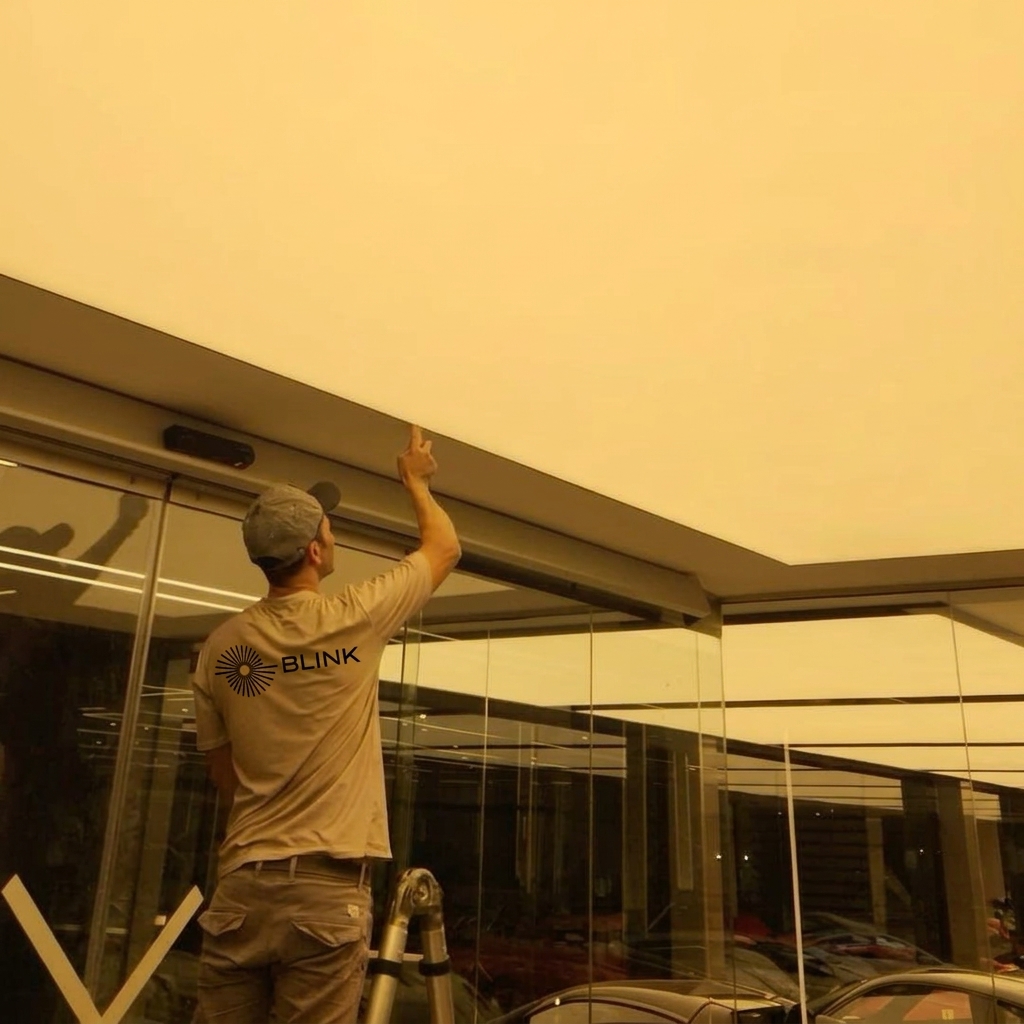
Backlit Stretch Ceiling Installation for Villas in Dubai and Abu Dhabi
A ceiling can do something pretty remarkable when it becomes a source of light.
Just ask homeowners and villa owners who have installed stretch ceilings in UAE .
Instead of seeing individual downlights or a collection of fixtures, you see one smooth, luminous surface that makes the entire room feel brighter and more open.
That’s basically the idea behind a backlit stretch ceiling.
A translucent membrane sits beneath a concealed lighting system, allowing light to pass through and spread across the visible surface.
For luxury villas in Dubai and Abu Dhabi, this can create a distinctive feature in living rooms, entrance halls, kitchens, bedrooms, and double-height spaces.
It can also complement contemporary interiors where clean ceiling lines and concealed lighting are important parts of the design.
But here’s the catch: installing a backlit stretch ceiling isn’t simply a matter of placing LED lights above a translucent sheet.
You need a ceiling light installation service to do it right in the UAE.
The membrane, LED layout, cavity depth, electrical equipment, mounting profiles, and maintenance access all influence how the finished ceiling will perform.
A poorly coordinated system may reveal bright spots, visible LED lines, dark edges, or uneven color.
A properly designed system aims to produce a smooth, consistent glow that looks intentional from different viewing angles.
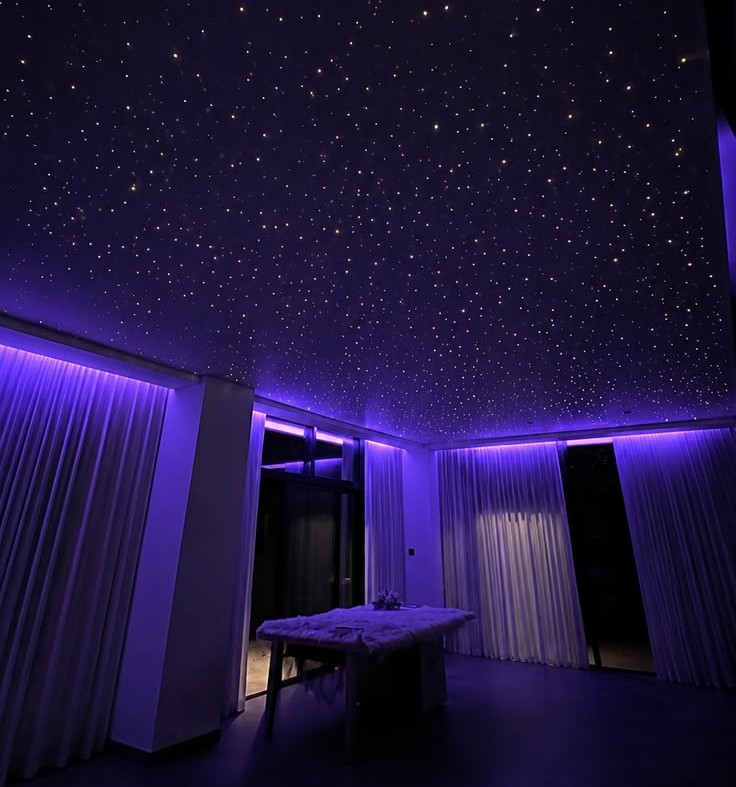
BACKLIT STRETCH CEILING INSTALLATION IN DUBAI AND ABU DHABI
Before installation begins, it helps to understand what sits behind the finished surface.
A backlit stretch ceiling is a coordinated assembly of a translucent membrane, perimeter profiles, supporting structure, lighting equipment, electrical components, and the space between the original ceiling and the membrane.
Each component contributes to the final appearance and performance that we can notice in many cases of stretch ceilings for luxury villas.
What Is a Backlit Stretch Ceiling?
A backlit stretch ceiling uses a translucent membrane that diffuses light from a concealed source behind it.
The membrane becomes the visible luminous surface, while the LED system remains hidden from normal view.
Depending on the product, the membrane may be made from PVC film or a specialized textile-based material.
These materials have different optical characteristics and installation requirements, so the selected system should be specified as a complete assembly.
The goal is to make the visible surface appear evenly illuminated rather than revealing the individual light sources behind it.
The Main Components of Backlit Stretch Ceiling
A typical installation includes the following components:
- Translucent membrane: The visible surface that diffuses light from behind.
- Perimeter profiles: The fixing system that holds the membrane under tension.
- LED lighting system: The modules, strips, or suitable luminaires that provide illumination.
- Supporting structure: The construction used to mount the lighting and associated equipment.
- Power supplies and controls: The drivers, wiring, dimming equipment, and control devices required by the system.
- Plenum or cavity: The space between the existing ceiling or supporting structure and the translucent membrane.
The exact components and their arrangement depend on the manufacturer’s system and the project design.
How the Light Passes Through the Membrane?
The LEDs illuminate the back of the translucent sheet, which diffuses the light across the visible ceiling.
The result depends on the membrane’s transmission properties, the distribution of the light sources, the distance between the LEDs and the sheet, and the surfaces inside the cavity.
The cavity should not be treated as empty space with no design requirements. Its depth, cleanliness, reflectance, and configuration can influence the final appearance.
For example, visible bright spots may appear when the LEDs are too close to the membrane or when the lighting pattern does not suit the selected material.
Why Product Compatibility Matters?
Not every translucent membrane is designed to work with every LED system.
A combination that looks promising on paper may produce uneven illumination or may not meet the installation requirements of the selected products.
The supplier should identify the membrane model, compatible lighting system, recommended cavity arrangement, and relevant technical documentation before installation begins.
A sample assembly can help verify the intended appearance before the full ceiling is produced.
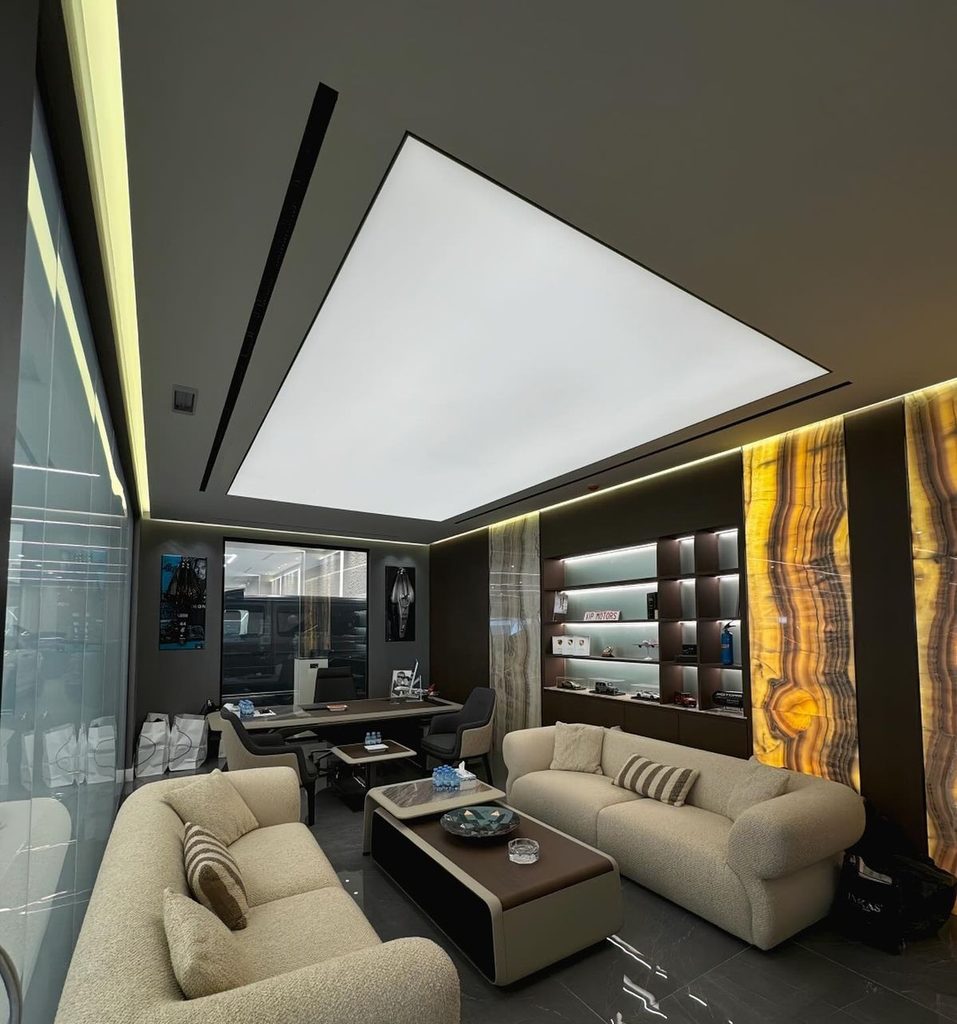
TRANSLUCENT MEMBRANE AND LED LIGHTING SYSTEM
The membrane and lighting equipment need to be selected together.
This is particularly important for large ceilings, where small inconsistencies in light distribution can become visible across the entire surface.
The right specification depends on the desired brightness, the room’s purpose, the ceiling dimensions, and the technical capabilities of the chosen system.
Selecting a Suitable Translucent Membrane
Translucent stretch ceiling membranes are designed to transmit and diffuse light, but their optical properties vary.
Some membranes are developed for luminous ceilings, while others may be intended for different decorative applications.
The product’s documented transmission properties should guide the choice.
The membrane’s color and finish also affect the appearance of the illuminated surface.
A sample viewed under the proposed lighting conditions can help confirm whether the result suits the interior design.
The LED Configuration
Backlit stretch ceilings may use LED modules, strips, linear systems, or other compatible lighting arrangements.
The correct configuration depends on the ceiling’s dimensions, the membrane, available cavity depth, and the required light distribution. A system designed for a small feature panel may not be appropriate for a large living room ceiling.
Product data should be reviewed to determine the required mounting arrangement, electrical load, driver configuration, and control compatibility.
Color Temperature and Color Consistency
Correlated color temperature, measured in kelvins, describes the apparent warmth or coolness of white light.
Warm-white illumination is often selected for residential spaces intended to feel relaxed, while more neutral white may suit some contemporary interiors.
The appropriate choice depends on the design concept and how the ceiling relates to the surrounding materials.
Color consistency matters as well. If the ceiling uses multiple LED modules, noticeable variations between sources can create patches that appear warmer or cooler than the rest of the surface.
The lighting specification should therefore establish appropriate color requirements and use compatible products from a coordinated system.
Selecting Dimmable or Color-Changing Lighting
Dimming can let the homeowner adjust the luminous ceiling for different activities.
A living room may need stronger illumination during cleaning and a softer setting when relaxing in the evening.
Some systems also allow color changes through compatible LED and control equipment. These features can be useful in selected entertainment areas, but they should be included only when they serve a clear purpose.
The LEDs, drivers, dimmers, and control system must be compatible. Otherwise, the installation may produce flickering, limited dimming performance, or inconsistent operation.
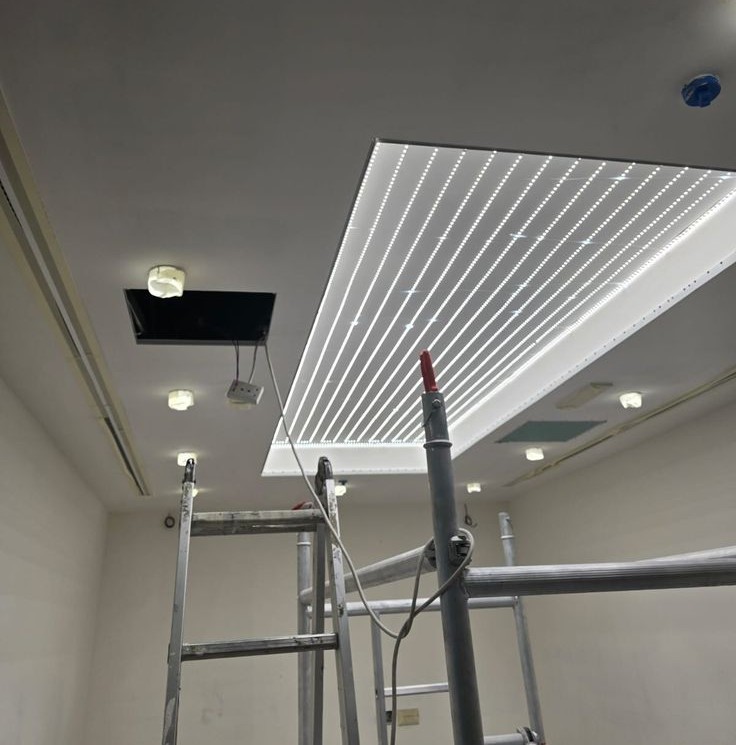
CAVITY DEPTH AND LED SPACING FOR UNIFORM LIGHT
One of the biggest technical challenges is producing a continuous luminous surface without visible bright spots, stripes, or dark patches.
That requires the lighting system to be designed around the membrane and cavity rather than installing LED sources at arbitrary distances.
Why Cavity Depth Matters?
The space between the LEDs and the membrane affects how much the light spreads before reaching the visible surface.
If the sources are too close, their individual positions may become visible through the membrane.
Increasing the distance can give the light more room to spread, although the correct dimension depends on the entire system.
Barrisol’s published LED lighting guidance specifies a 150 mm space for its described homogeneous lighting system and states that the distance between the LEDs and the membrane should not be less than 100 mm.
These are Barrisol-specific recommendations, not universal dimensions for every stretch ceiling system.
The actual cavity depth should follow the selected manufacturer’s technical documentation and the requirements of the project.
LED Spacing and Light Distribution
The distance between LED modules or rows also influences uniformity. A suitable arrangement allows their individual light distributions to overlap at the membrane.
If the spacing is too wide for the available cavity depth, dark stripes may appear. If the LED pattern is poorly matched to the membrane, brighter areas may become visible.
The designer should use the photometric information and installation guidance for the actual lighting system, not apply one universal spacing formula to every ceiling.
Reflective Surfaces Inside the Cavity
Barrisol recommends a white cavity for its described LED stretch ceiling system to help reflect light toward the membrane.
This illustrates an important design principle: the supporting cavity can influence how evenly light reaches the visible surface.
The exact finish and construction should follow the selected product’s requirements.
The supporting surface, wiring, ventilation, and any other components should be coordinated before the membrane is installed.
Dust and Insects from Entering the System
Contamination inside the cavity can become visible if it affects the membrane or the appearance of the luminous surface.
Barrisol recommends closing the relevant space against dust and insects and describes an additional transparent sheet in its system guidance as a measure to protect the luminous assembly.
That detail should not automatically be copied into unrelated systems. Ask the supplier whether an additional protective layer is required or recommended for the exact product installed.
Testing the Lighting Before Installing the Membrane
The lighting should be tested before the membrane conceals the equipment.
This is the opportunity to inspect the LED arrangement, verify electrical connections, and look for obvious inconsistencies in output.
Where practical, a representative test panel can help reveal hot spots, stripes, and color variations before the full installation proceeds.
Corrections are usually easier while the system remains accessible.

THE INSTALLATION PROCESS OF BACKLIT STRETCH CEILING
A well-managed installation begins with accurate measurements and finishes with a series of functional and visual checks.
For villas in Dubai and Abu Dhabi, the sequence should be coordinated with ceiling works, electrical installation, lighting controls, and other building services.
Step 1: Site Survey and Measurement
The installer measures the ceiling area and reviews the surrounding walls, ceiling levels, columns, beams, and other architectural features.
The survey should also identify electrical points, ventilation elements, sprinklers, detectors, lighting positions, and any other services that need to pass through or be integrated into the finished ceiling.
For custom shapes or large installations, the team should confirm the drawing revision and dimensions before the membrane is manufactured.
Step 2: Finalize the Design and Technical Details
The design should establish the membrane type, finish, perimeter profile, cavity arrangement, and lighting configuration.
The team should also confirm the positions of downlights, access openings, suspended fixtures, and other elements that require special mounting details.
Changes made after the membrane is produced can cause delays or require replacement parts, so the design should be reviewed before fabrication.
Step 3: Prepare the Supporting Structure
The perimeter profiles are installed at the intended height and secured according to the system’s instructions.
The supporting structure for the LED equipment must also be suitable for the installation.
The membrane itself should not be treated as a load-bearing support for luminaires or other heavy components.
Any required reinforcement or mounting platforms should be installed before the ceiling is closed.
Step 4: Install the LED System and Electrical Components
The lighting equipment is installed in its planned positions, with suitable wiring, drivers, and controls.
The installer should follow the manufacturer’s instructions regarding spacing, electrical connections, component mounting, and required clearances.
Electrical installation should be performed by appropriately qualified personnel in accordance with the applicable requirements.
Step 5: Test the Lighting Arrangement
Before the membrane is fitted, the team should power up and inspect the lighting system.
This includes checking that the intended lighting groups operate correctly and reviewing the output for visible inconsistencies.
Where dimming or color-changing functions are specified, these should be tested with the intended control equipment.
The team should also verify that drivers and other components are positioned appropriately and remain accessible where required.
Step 6: Install the Stretch Membrane
The membrane is fitted using the installation method specified for the selected product.
Certain PVC systems use controlled heat to make the membrane flexible during installation. Textile-based systems may use different fixing and tensioning methods.
The installer should follow the manufacturer’s procedure rather than assuming that all stretch ceiling products can be fitted in the same way.
Step 7: Complete the Finishing and Handover
Once the membrane is secured, the installer checks its appearance, perimeter details, and the integration of lighting fixtures and other components.
The lighting should be operated again to confirm that the finished surface looks consistent and that controls work as intended.
The handover should include relevant product details, cleaning instructions, warranty information, and the process for accessing components that may require future maintenance.
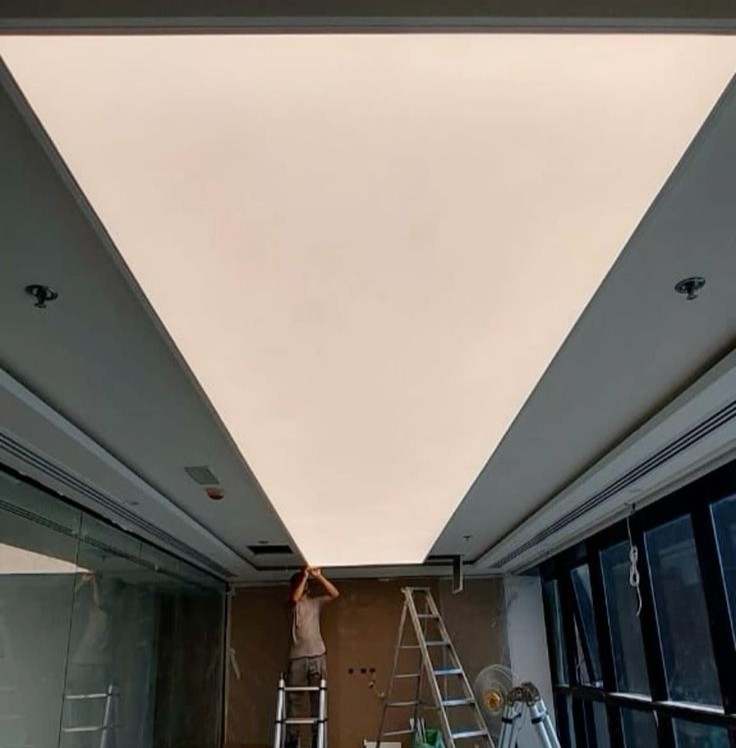
HOW TO AVOID HOT SPOTS AND DARK PATCHES?
A backlit ceiling can look simple once installed, but the uniform appearance depends on several technical decisions working together.
The most important is ensuring that the light reaching the membrane is distributed consistently across its surface.
What Causes Visible LED Dots?
Visible dots often indicate that the light sources are too close to the membrane, their spacing is unsuitable, or the membrane does not diffuse the light as expected.
The problem may also be influenced by the optical distribution of the LEDs and the reflective properties of the cavity.
The solution should be based on the actual cause. It may involve changing the LED layout, adjusting the cavity depth, selecting a different optical system, or using a compatible membrane.
What Causes Stripes and Uneven Brightness?
Stripes can occur when LED rows are spaced too far apart for the available mixing distance. Darker edges may appear if the perimeter lighting arrangement does not compensate for the geometry of the ceiling.
Irregular mounting surfaces or inconsistencies in the LED output can also affect the result.
The layout should be reviewed as a complete lighting system rather than correcting one component without considering the others.
The Edges and Corners
A large luminous ceiling can appear uniform in the center while showing darker areas near its edges.
This can happen when the light sources, cavity geometry, and perimeter details have not been coordinated properly.
The designer should pay particular attention to corners, recesses, columns, and any areas where the ceiling changes direction.
The Complete Surface
A small sample may demonstrate the appearance of the membrane, but a larger representative test can provide more useful information about uniformity.
The evaluation should consider the actual light output, dimming range, and intended viewing conditions.
The team should also verify that the installed products match the approved specification.
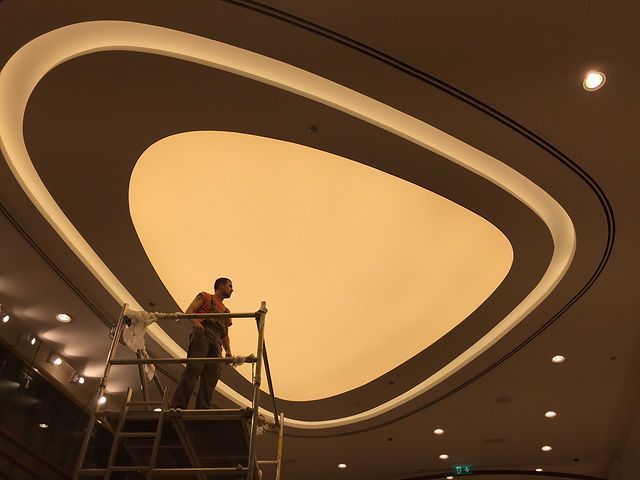
INTEGRATING DOWNLIGHTS, AIR CONDITIONING, ETC.
A backlit stretch ceiling needs to work with the other services in the room.
Lighting, ventilation, detectors, sprinklers, and access panels should be coordinated before the membrane is fitted.
The challenge is to preserve the ceiling’s appearance without compromising required building functions or future maintenance.
Recessed Downlights and Decorative Fixtures
Some projects combine a luminous ceiling with selected downlights or decorative luminaires.
The design should establish how these sources work together and whether they need separate control zones.
Fixtures that pass through the membrane require compatible supports and properly detailed openings. Heavy pendants and chandeliers need suitable independent support arrangements as required by the fixture and ceiling system.
The mounting details should be agreed upon before the membrane is installed.
Air Vents and Mechanical Services
Air-conditioning grilles and ventilation elements should be coordinated with the ceiling layout.
The team should confirm the required openings, mounting frames, and clearances, while maintaining access to relevant equipment.
The exact integration method depends on the stretch ceiling product and the mechanical component.
Smoke Detectors and Sprinklers
Required safety devices must remain functional and be installed in accordance with the approved building design and applicable requirements.
The stretch ceiling arrangement should not obstruct detectors, sprinkler coverage, or access to other required equipment.
These elements should be coordinated by the relevant professionals and installed according to their approved details.
Driver Access and Maintenance Openings
LED drivers and related electrical components may need inspection, replacement, or adjustment during the system’s life.
The project should identify how those components will be accessed without causing unnecessary damage to the finished ceiling.
Where a system allows the membrane to be removed and refitted, confirm the manufacturer’s procedure and the conditions under which that work can be performed.
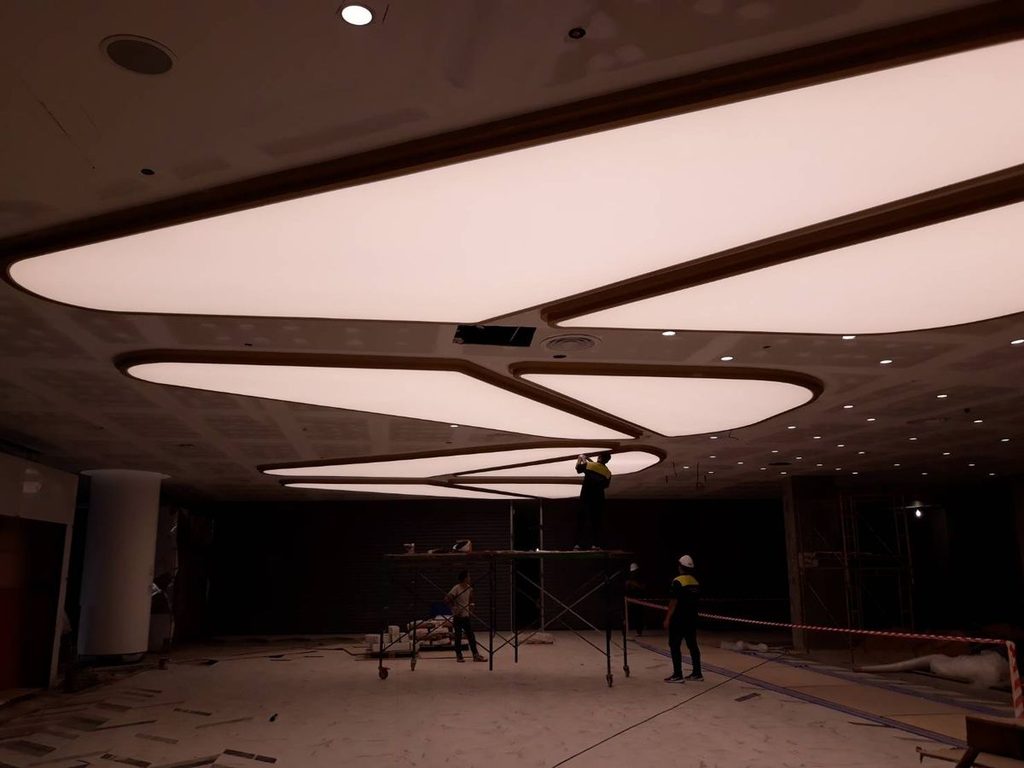
BACKLIT STRETCH CEILINGS IN DIFFERENT SPACES
Stretch ceilings are not just for villas or homes. They can be a part of commercial lighting design for stores and showrooms.
Different rooms need different ceiling designs.
A large luminous ceiling may work beautifully in a living room, while a smaller backlit feature may be more appropriate in a bedroom or entrance.
The design should reflect the room’s purpose and the way the homeowner intends to use it.
Living Rooms and Majlis Areas
In a living room, a backlit ceiling can provide a broad source of diffused illumination and create a clean visual plane.
It may be combined with decorative pendants, wall lighting, or accent fixtures to establish different lighting scenes.
The designer should consider the furniture layout, ceiling height, and the way the illuminated surface will appear from the main seating positions.
In a Majlis, the balance between general illumination and decorative lighting should support the intended atmosphere and the room’s cultural and functional use.
Entrance Halls and Double-Height Spaces
An entrance hall can benefit from a luminous ceiling that emphasizes the space’s height and geometry.
However, larger or double-height spaces may need careful coordination of the lighting output, ceiling proportions, and other architectural features.
The design should also consider maintenance access, especially where equipment is positioned above a high-level membrane or within a difficult-to-reach ceiling.
Kitchens and Dining Areas
A backlit ceiling can establish a clean architectural appearance in a kitchen or dining area.
But the ceiling’s ambient light may not provide all the task lighting required for food preparation, reading, or other activities. Additional lighting may still be necessary over counters, work surfaces, or dining tables.
The selected membrane and lighting components should also be suitable for the actual environmental conditions.
Bedrooms and Dressing Rooms
A translucent ceiling can provide soft, distributed light in a bedroom, while a smaller illuminated feature can create a more restrained effect.
Dimming may be useful where the system is designed to support both brighter functional lighting and softer evening settings.
Dressing areas may still require appropriate task lighting and color rendering to help clothing and finishes appear as intended.
Bathrooms and Spa-Inspired Spaces
Bathrooms and spa-inspired interiors can use backlit ceiling features, but the product and electrical arrangements must suit the environment.
The membrane should not be assumed to provide waterproofing or to eliminate the need for suitable ventilation.
The complete construction and installation should meet the applicable requirements for the space.
The supplier should explain the system’s moisture limitations, maintenance procedure, and product documentation before it is specified.
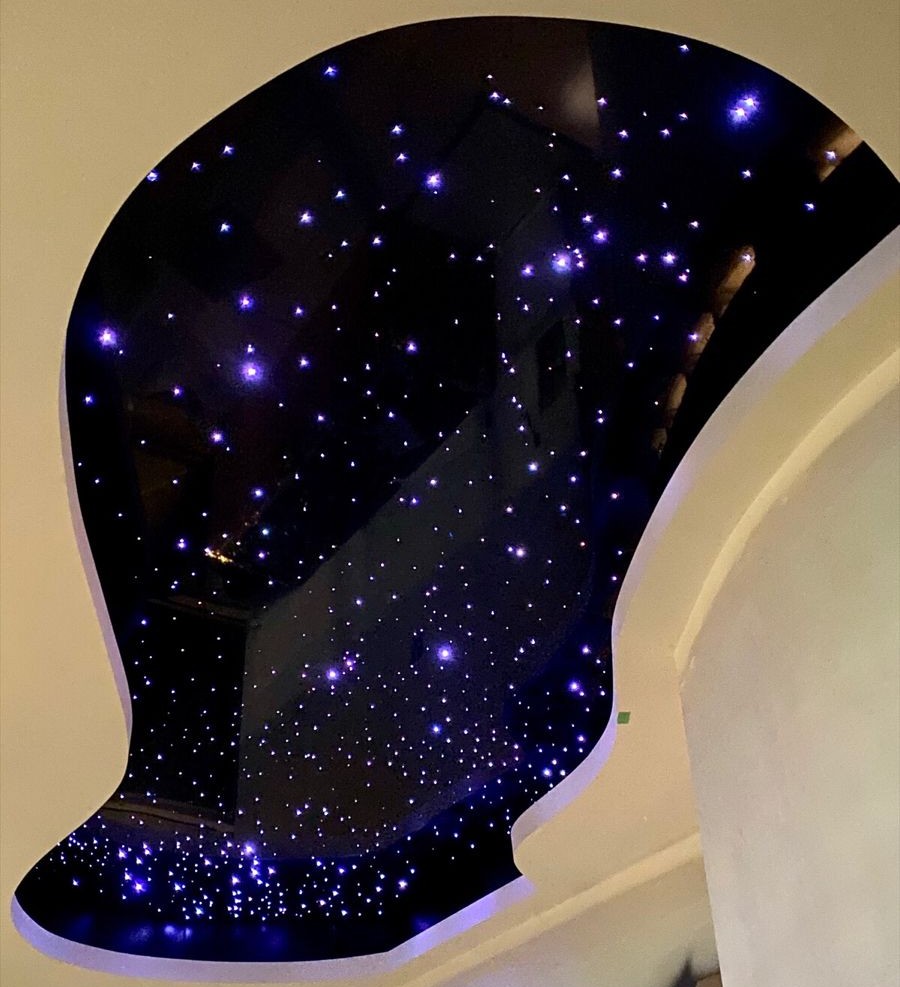
BACKLIT STRETCH CEILING SUPPLIER AND INSTALLER IN DUBAI AND ABU DHABI
A good backlit stretch ceiling depends on coordinated product selection and installation.
Of course, you can ask a lighting consultant in UAE to guide you through the process.
The supplier should be able to identify the actual products, explain the system requirements, and provide a realistic installation and maintenance plan.
Verify the Membrane and Lighting System
Ask for the manufacturer’s name, exact membrane type, finish, and technical documentation.
The proposed LED equipment should be identified as part of the complete system, including any requirements for cavity depth, spacing, power supplies, controls, and access.
Avoid making decisions based solely on photographs or generalized claims about uniformity.
Review Local Experience and Installation Support
For a UAE project, ask whether the supplier can coordinate measurement, fabrication, delivery, installation, and handover.
Barrisol publishes an installer directory that includes an authorized distributor in Dubai.
This is one possible starting point when considering that manufacturer’s systems, although homeowners should still check the precise product, project scope, and warranty terms.
Experience with a plain stretch ceiling does not automatically demonstrate experience with a large luminous ceiling, so review examples relevant to the proposed application.
Compare Quotations by Scope
A quotation should identify the membrane, profiles, LED equipment, controls, installation, and any other required work.
It should also make clear whether electrical modifications, supporting structures, access arrangements, testing, and handover documentation are included.
This helps compare proposals fairly and reduces the risk of discovering important exclusions after work has begun.
Confirm Warranty and Aftercare
Ask who provides the material warranty and what conditions apply.
Confirm how the ceiling can be cleaned, how equipment is accessed, and who is responsible if a component fails.
The warranty should correspond to the actual product supplied. Do not assume that a material warranty covers every electrical component or every installation condition.

COST, MAINTENANCE, AND LONG-TERM PERFORMANCE
The cost of a backlit stretch ceiling depends on more than the visible membrane. However, it might range between 2500-6000 AED.
The lighting system, cavity arrangement, perimeter profiles, controls, room geometry, and installation conditions all influence the final price.
What Affects Installation Cost?
Important factors include the ceiling area, membrane type, profile system, required cavity depth, lighting output, control features, and the complexity of the room.
A simple luminous feature panel may require less work than a large, continuous ceiling with several integrated services and multiple lighting scenes.
The most useful quotation identifies these components separately so the owner can understand what is being supplied.
Cleaning and Routine Maintenance
Maintenance should follow the manufacturer’s instructions for the selected membrane and system.
The project should also establish how the LED system, drivers, and other concealed components can be inspected or replaced.
Access requirements may be different for a removable membrane and a system with more restrictive installation details.
Long-Term Operating Considerations
The operating cost depends on the installed power, daily use, selected output, and control strategy.
Efficient LED equipment and suitable dimming may help manage consumption, but the actual result depends on the specified products and how the system is operated.
The design should balance visual quality with practical performance rather than selecting the brightest possible arrangement.
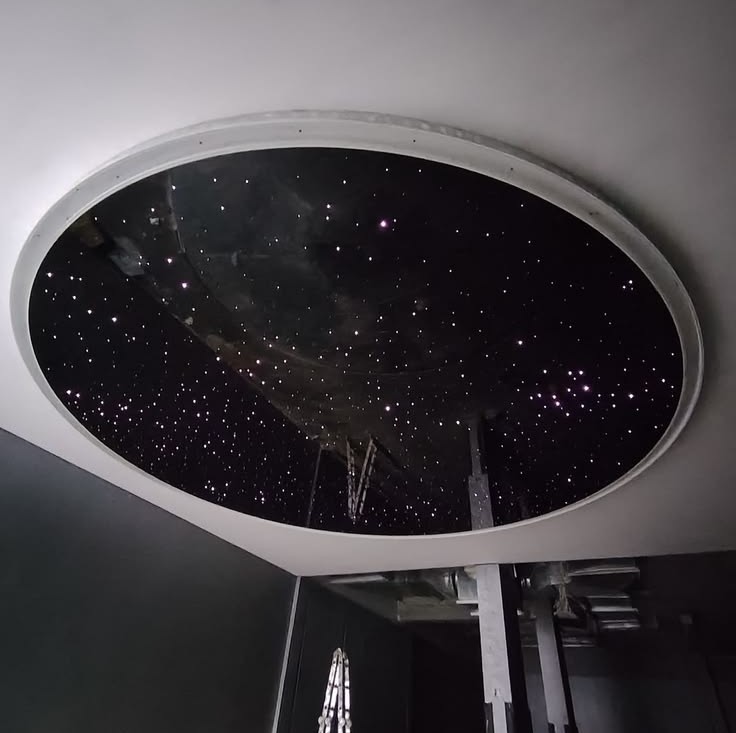
FINAL THOUGHT
Backlit stretch ceiling installation is a coordinated design and construction process. The membrane, lighting layout, cavity depth, profiles, electrical components, and building services all contribute to the final result.
For villas in Dubai and Abu Dhabi, the most important decisions should be made before installation begins.
Accurate measurements, suitable products, a tested LED arrangement, and clearly defined maintenance access can help avoid visible lighting defects and unnecessary rework.
A luminous ceiling can become a distinctive feature in a luxury interior, but its appearance depends on more than the membrane alone.
The lighting system behind it must be designed and installed with the same attention to detail as the surface people see.
When those elements work together, the result is a smooth, controlled glow that supports the architecture and gives the room a refined appearance.
Related Posts

Ceiling Light Installation Service for Villas, Hotels, and Residential Projects in the UAE
Stretch Ceiling for Luxury Villas in Dubai and Abu Dhabi
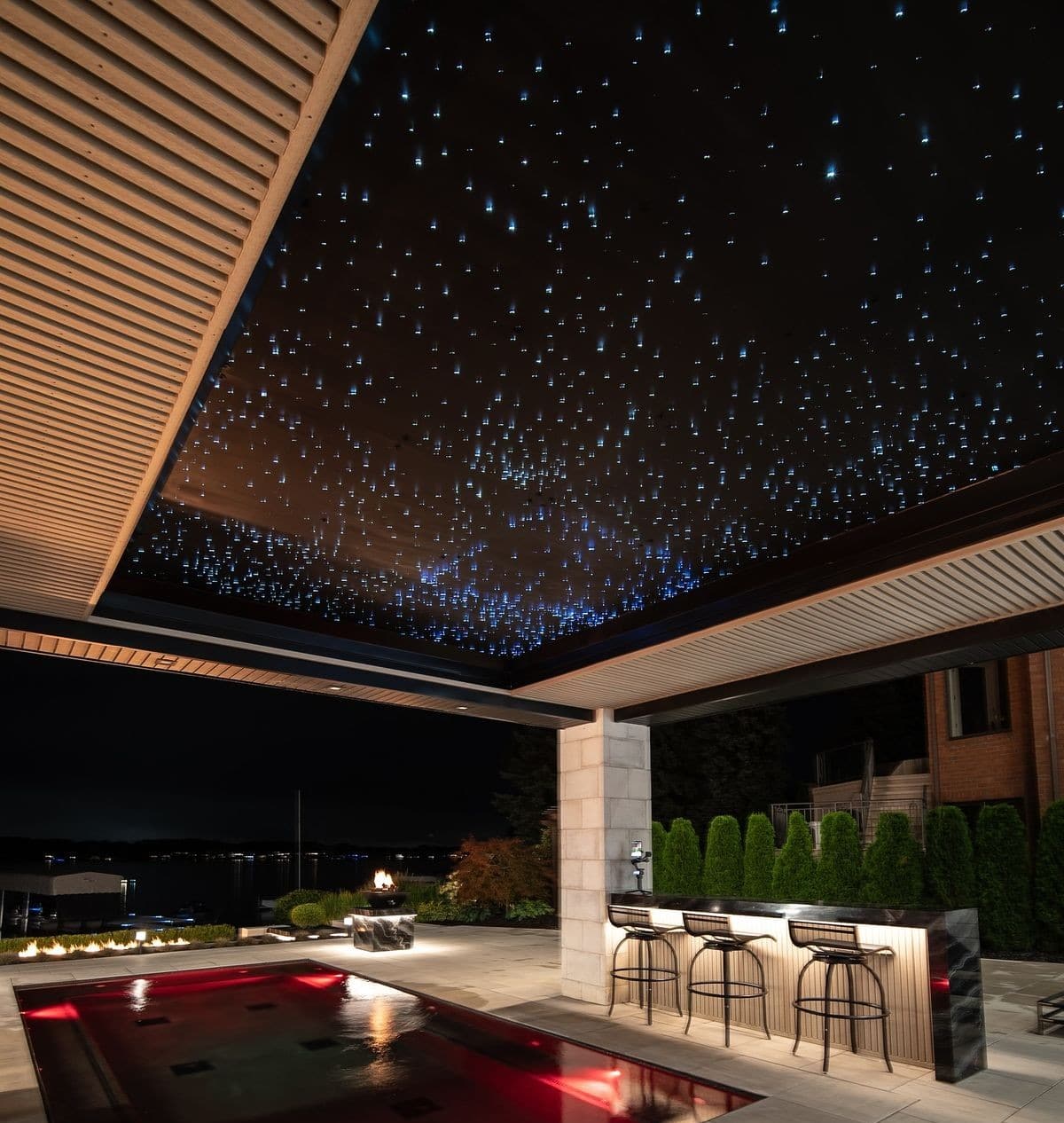
Stretch Ceiling in UAE: Backlit, Glossy, Mirror, Matte, and Custom Designs
