High Bay LED Lights in UAE: Best Options for Warehouses and Factories
A warehouse can look bright from the loading door and still have a lighting problem.
One aisle might be well lit, another might feel gloomy, and a worker reading a label on a high shelf might struggle to see the details clearly.
That’s why choosing high bay LED lights involves more than finding a powerful fixture and hanging it from the ceiling.
The lighting must reach the working surfaces, distribute light evenly, control glare, and operate reliably in the building’s actual condition.
In the UAE, warehouses, factories, workshops, logistics centers, and large commercial facilities can have very different requirements.
Dealing with these requirements requires the effort of a lighting consultant with a deep expertise in industrial lighting.
A temperature-controlled distribution center needs a different specification from a dusty production area, while a high-rack warehouse needs a different lighting layout from an open factory floor.
HIGH BAY LED LIGHTS IN DUBAI AND ABU DHABI
High bay LED lights illuminate spaces with relatively high ceilings, where ordinary ceiling fixtures such as track lights may struggle to deliver enough useful light to the working area.
You’ll commonly find them in warehouses, factories, logistics facilities, assembly plants, large workshops, indoor sports facilities, and other buildings with substantial mounting heights.
Their optical design directs light toward the floor, equipment, storage racks, and workstations rather than wasting it across the ceiling.
The exact mounting height depends on the building and application.
Many industrial lighting guides use approximately 6 meters as a practical reference for high-bay applications, but the ceiling height alone does not determine the correct fixture.
Light distribution, rack height, task requirements, and mounting positions matter just as much.
Lighting design for large residential projects often includes quotations and the procurement of high-performance high bay LED lights.
LED Warehouse Lighting Is More Than Brightness
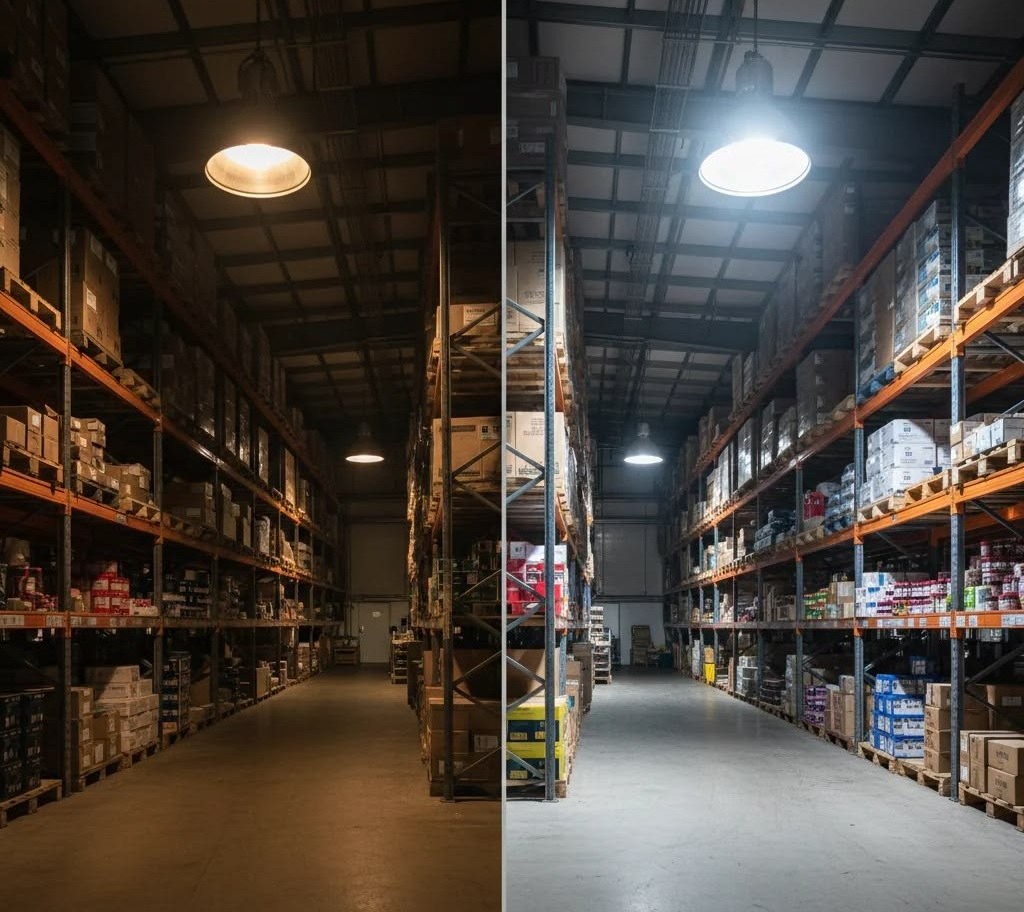
Good LED warehouse lighting allows people to move around, identify goods, read labels, operate equipment, and perform their tasks without unnecessary visual strain.
A fixture with a high lumen output can still produce a poor result if it creates bright patches directly below the lights and dark spaces between them.
The same problem can occur when tall racks block light from reaching stored products.
The design should consider horizontal illumination on the floor and work surfaces, as well as vertical illumination on rack faces.
Vertical light helps workers read labels and identify products stored above or beside them.
The international standard ISO/CIE 8995-1:2025 addresses workplace lighting in terms of both quantity and quality, including visual comfort, performance, and safety.
Its approach supports a task-based design rather than a one-size-fits-all wattage recommendation.
High Bay LED Shop Lights for Workshops and Service Areas
High bay LED shop lights can work well in large workshops, maintenance facilities, automotive service areas, and production spaces with high ceilings.
These environments often combine open floor space with machinery, benches, vehicles, and detailed manual work.
The lighting plan should therefore provide comfortable general illumination while directing enough light toward the areas where workers inspect, repair, assemble, or process equipment.
Color rendering also matters. Workers may need to distinguish colored wires, paint finishes, warning labels, components, or material defects.
A fixture’s CRI and color quality can affect how easily they see those details.
For workshops with different task zones, consider combining overhead high bays with localized task lighting.
That approach can provide better visibility at a workbench without forcing the entire building to operate at unnecessarily high light levels.
Commercial High Bay LED Lights for Large Indoor Spaces
Commercial high bay LED lights serve more than industrial buildings.
Large retail spaces, indoor sports facilities, exhibition halls, distribution centers, and other expansive buildings may also benefit from high-bay fixtures.
When it comes to retail lighting, the requirements vary with the activity.
A warehouse storing bulky packages may prioritize safe movement and product identification, while a sports space may need careful glare control and consistent illumination across the playing surface.
Large commercial spaces may also use daylight through skylights or roof glazing.
A 3D lighting design can account for that daylight and use compatible controls to reduce artificial light when the space receives enough natural illumination.
The key is to select the complete lighting system around the building’s use, rather than treating every high-ceilinged space as the same application.
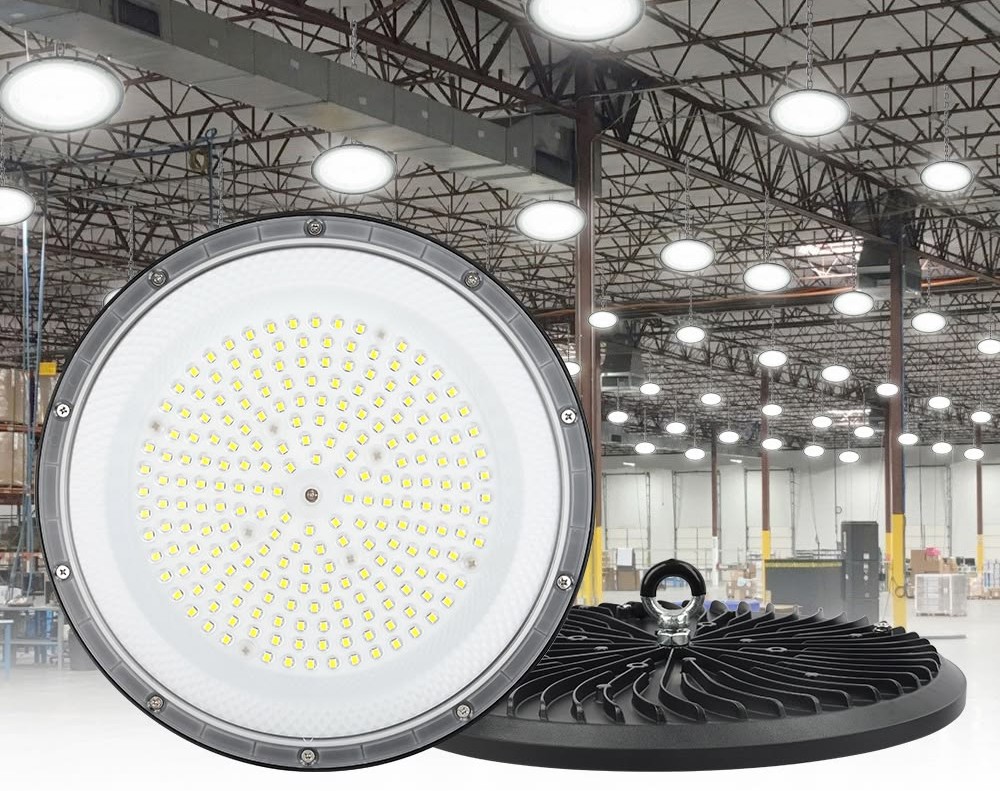
TYPES OF HIGH BAY LED LIGHTS FOR WAREHOUSES AND FACTORIES
The right fixture shape depends on the space, the desired light distribution, and the way the building operates. Two common choices are round UFO-style fixtures and linear high bays.
Other designs address specific mounting conditions, food-processing requirements, or hazardous industrial environments.
The shape is only one part of the decision; the optical system and technical specifications determine whether a product fits the application.
UFO LED Lights for Open Industrial Spaces
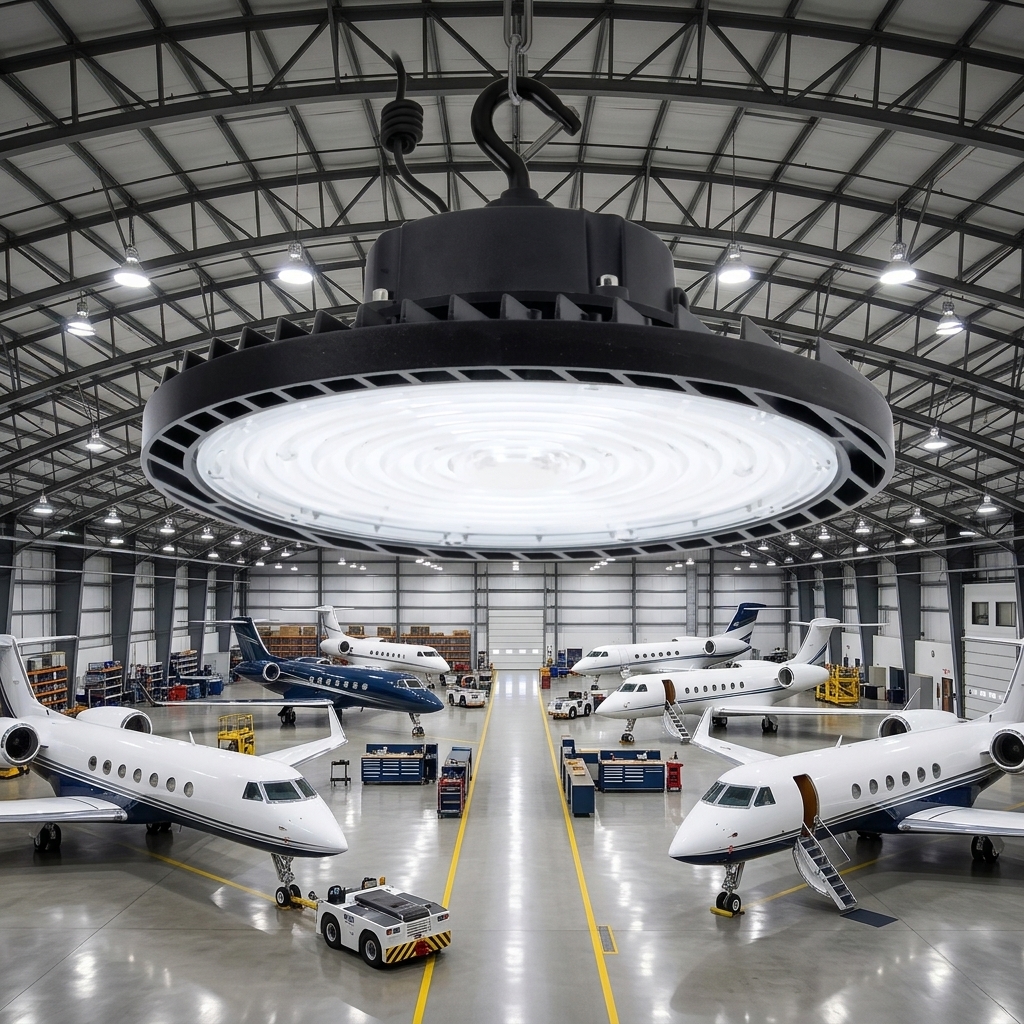
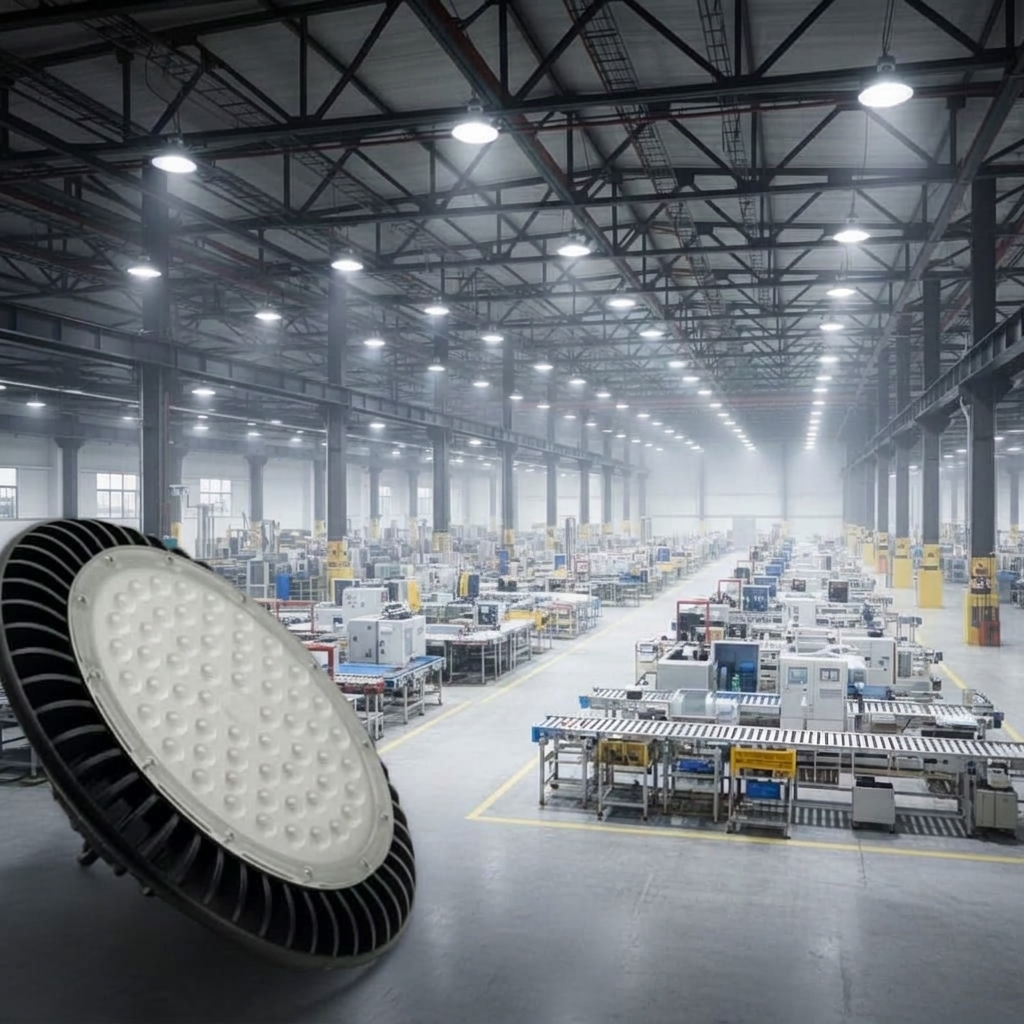
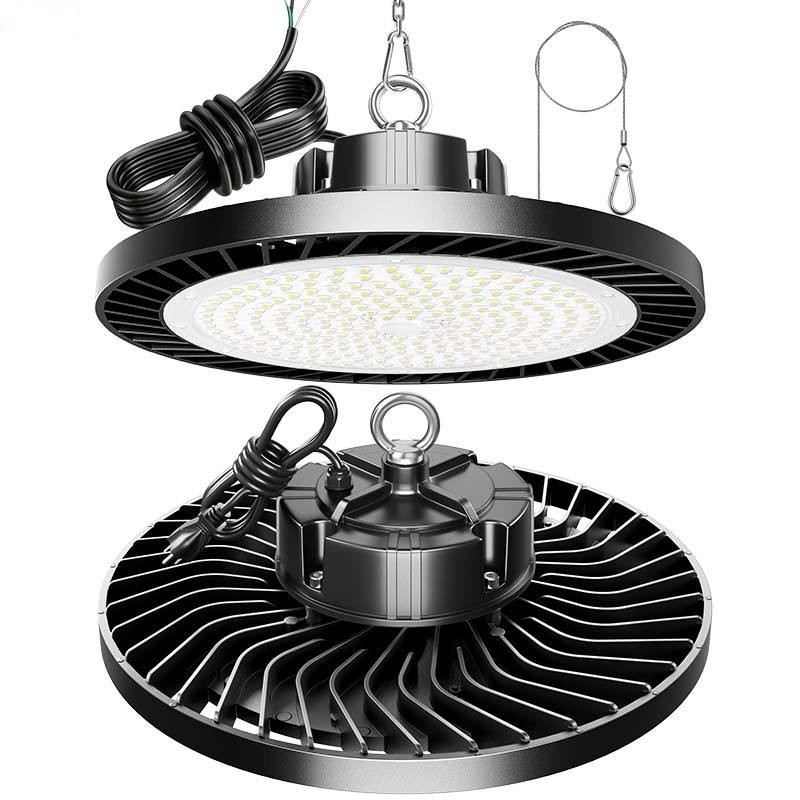
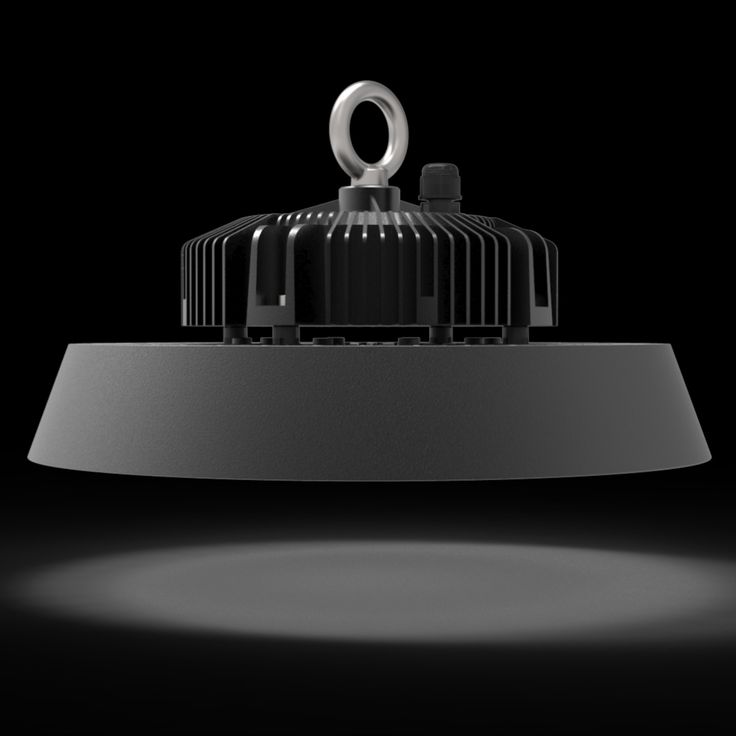
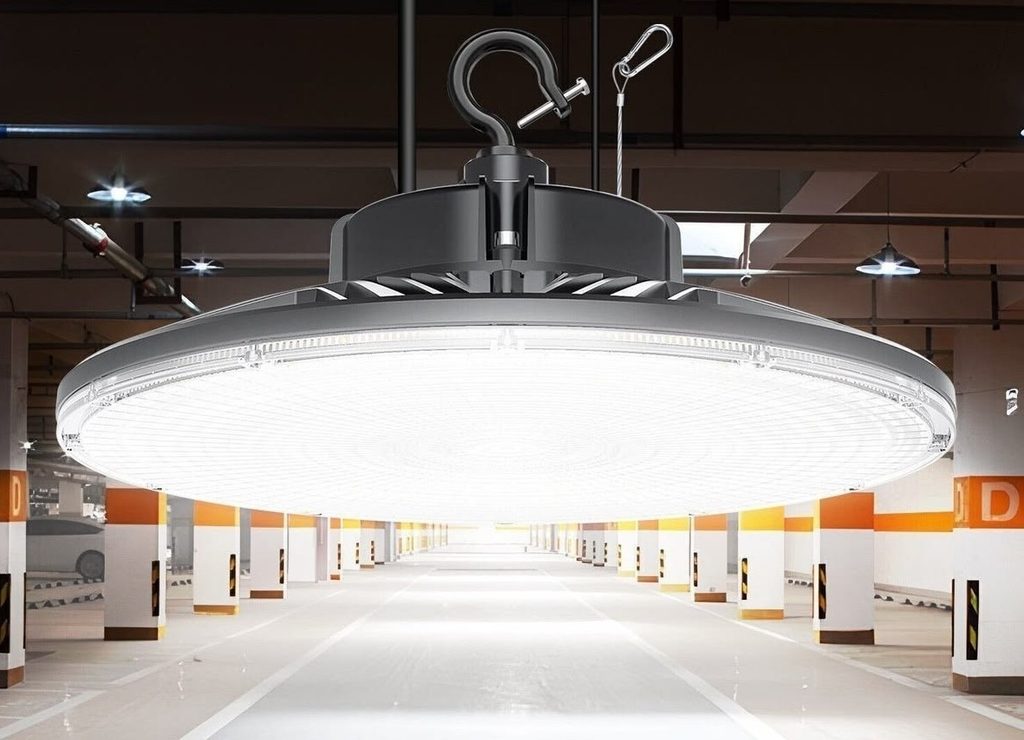
UFO LED lights have a compact, circular design.
Hence, their shape often makes them convenient for suspended installation in open warehouses, production halls, workshops, and other spaces that need relatively broad illumination.
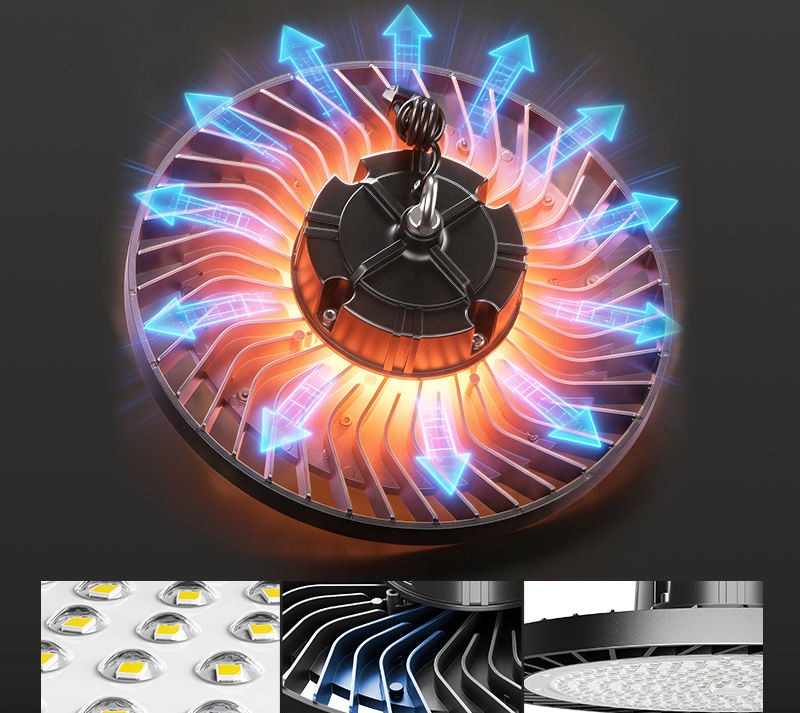
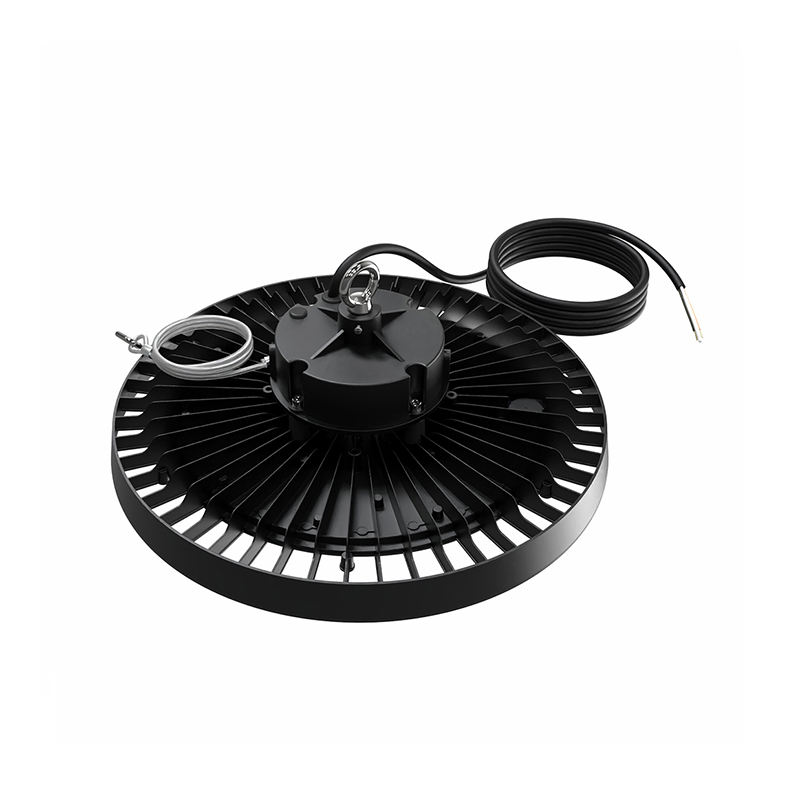
Many models use aluminum housings to manage heat and provide a compact fixture body.
Manufacturers offer different optical distributions, allowing designers to choose light patterns suited to mounting height and room layout.
However, a round fixture does not automatically provide uniform illumination in every direction or eliminate shadows.
Its beam distribution and the spacing between fixtures still determine how light reaches the floor.
UFO High Bay Light for Open Floor Plans
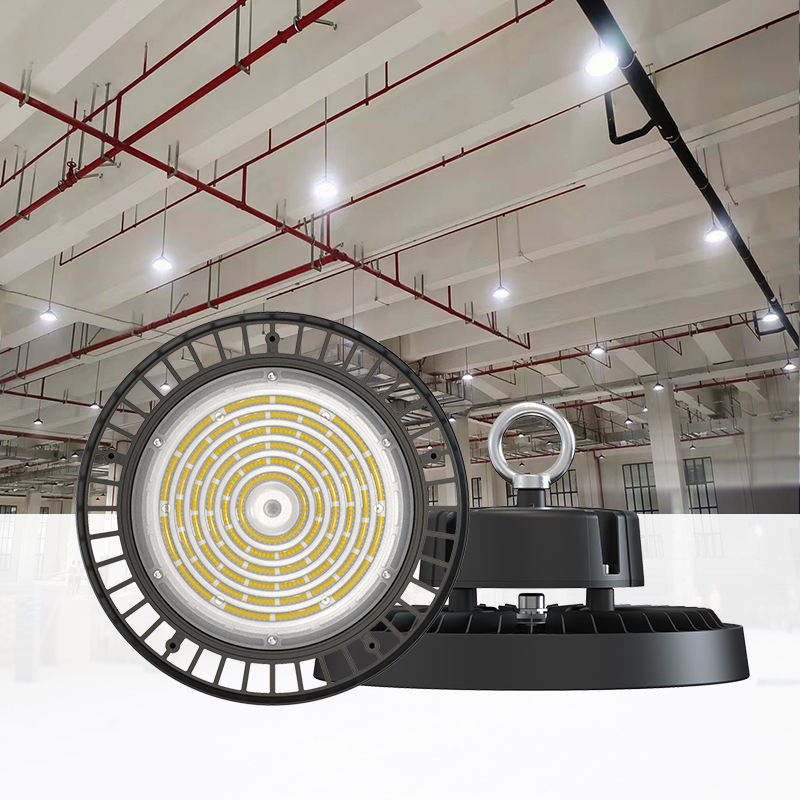
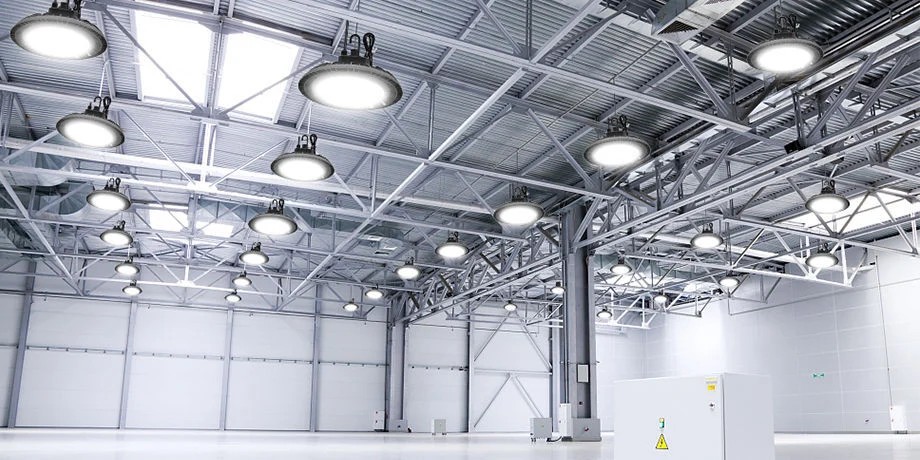
A UFO high bay light can suit an open warehouse where fixtures sit in a regular ceiling grid and illuminate broad floor areas.
For example, a high-ceilinged packaging area might use suspended round fixtures with an appropriate beam angle and mounting position.
The designer would then calculate the resulting illumination to check for dark gaps, excessive overlap, and glare.
A different optical distribution may be necessary when the space has tall machinery, large shelving units, or workers carrying out detailed tasks.
For this reason, compare photometric files and calculated layouts rather than choosing a UFO fixture based on its shape or advertised wattage alone.
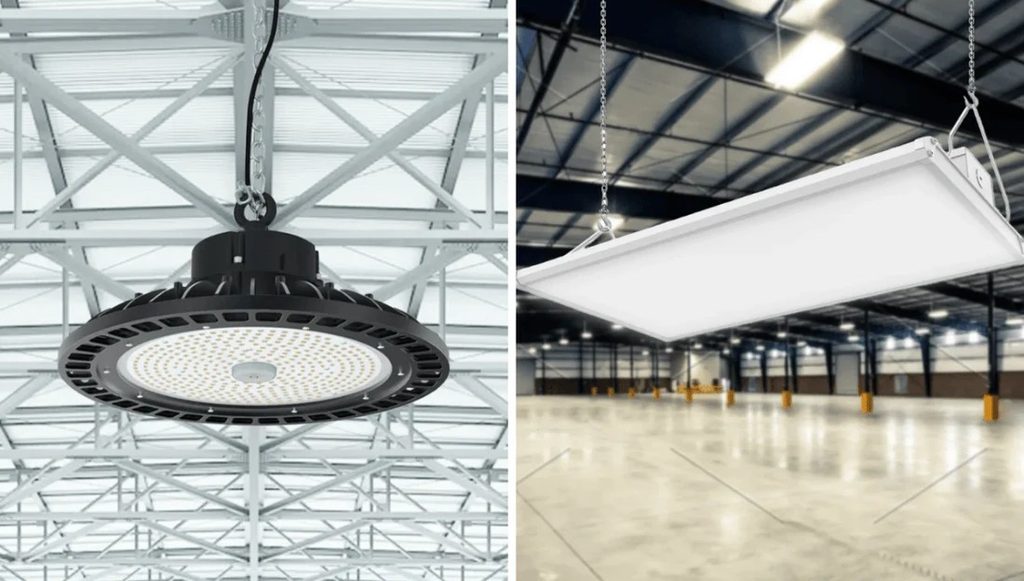
ROUND HIGH BAY LED LIGHTS VS. LINEAR HIGH BAY LED LIGHTS
Round high bay LED lights typically work well in open areas where a compact luminaire and broad distribution suit the layout.
Linear high bay LED lights can be more practical in long aisles, production lines, and distribution centers with rows of tall storage racks.
Their elongated shape allows designers to arrange fixtures along the direction of travel or between rack rows.
Neither format is automatically more efficient. Performance depends on the actual fixture, its light distribution, mounting position, and the illumination the application requires.
A photometric layout can show which arrangement delivers the right result with suitable uniformity and a sensible number of fixtures.
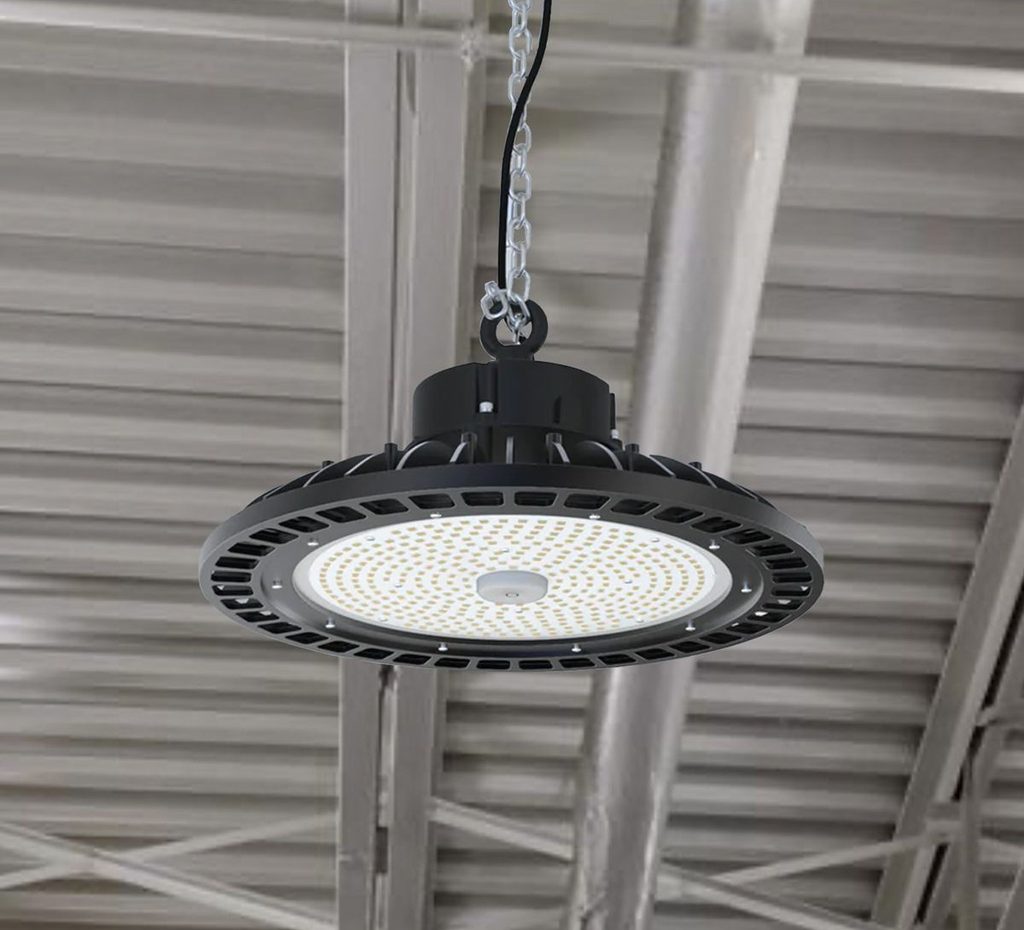
FLUSH MOUNT HIGH BAY LED LIGHTS
Flush mount high bay LED lights may suit installations where the building’s construction or mechanical layout favors a surface-mounted luminaire rather than a suspended fixture.
However, many traditional high bays rely on hooks, chains, or brackets that provide space around the housing. You should use a flush or surface-mounted arrangement only when the specific product supports that installation method.
The mounting method also affects heat dissipation, service access, and clearance from ceilings or other equipment.
Always follow the manufacturer’s light installation instructions and confirm that the mounting structure can support the fixture.
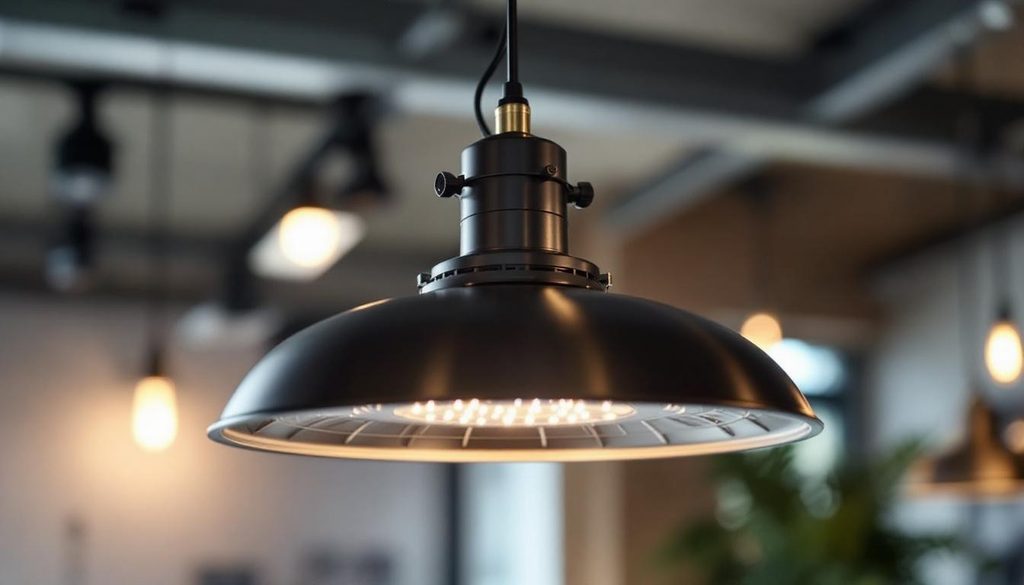
DECORATIVE HIGH BAY LED LIGHTS
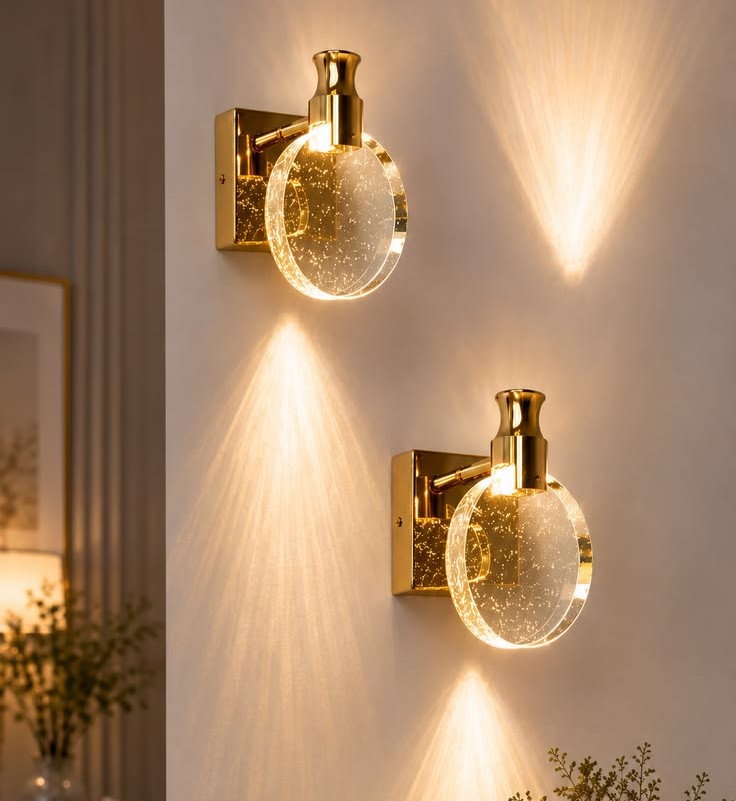
Decorative high bay LED lights are less common as a priority in warehouses than performance-focused industrial fixtures.
Still, some buildings need decorative led panel lights
that looks coordinated as well as functional.
This may apply to customer-facing showrooms, indoor sports clubs, exhibition spaces, and premium commercial interiors.
In those settings, the fixture’s finish and proportions may influence the choice, provided the product also meets the technical requirements.
For a conventional factory or distribution center, prioritize suitable light distribution, reliability, glare control, and serviceability before decorative appearance.
BEST HIGH BAY LED LIGHTS
The best high bay LED lights are not necessarily the most powerful or the ones with the longest advertised lifespan.
They are the fixtures that meet the application’s lighting requirements while offering appropriate efficiency, reliability, and maintenance costs.
A useful assessment starts with the space itself. Measure the mounting height, understand the building’s layout, identify the tasks people perform, and record any environmental conditions that could affect the equipment.
Start With Mounting Height and Floor Layout
Mounting height affects how light spreads before it reaches a working surface. As the fixture moves farther from that surface, the designer must consider whether its optical distribution can provide adequate illumination and uniformity.
Fixture spacing matters too.
Excessive spacing may create dark areas, while an unnecessarily dense layout can increase the initial cost and use more energy than the project needs.
The designer should also consider beams from nearby fixtures as a combined lighting system. A single fitting’s performance does not tell you how the complete warehouse will look.
For facilities with high-rack storage, include rack heights and aisle widths in the layout.
A plan based only on the floor dimensions may overlook the vertical surfaces where workers need to identify goods.
Understand Lux, Lumens, and Uniformity
Lumens measure the amount of visible light a fixture emits. Lux measures illuminance on a surface, with one lux equal to one lumen per square meter.
This distinction is important because a high-lumen product does not guarantee the required lux across the warehouse.
The result depends on mounting height, beam distribution, fixture spacing, room dimensions, surfaces, and losses over time.
Uniformity describes how evenly light reaches the relevant area. A high average illuminance can hide dark patches that create difficulty when workers move between aisles or examine products.
A professional lighting calculation should identify the target task surfaces and show how the proposed layout performs.
For complex facilities, the designer should also consider vertical illuminance, glare, and the changing conditions created by racking and machinery.
Check Lumens per Watt Instead of Comparing Wattage Alone
Wattage tells you how much electrical power a fixture consumes. Luminous efficacy, expressed in lumens per watt, shows how much light output it delivers for each watt of power.
A higher efficacy can reduce electricity use for a given amount of light, but compare products that serve the same application.
A narrow-beam fixture and a wide-beam fixture may deliver the same total lumens while producing very different lighting patterns.
Government procurement guidance uses luminaire efficacy to compare commercial and industrial LED products.
Published benchmarks can help buyers understand the metric, but requirements from another country do not automatically apply as UAE regulations.
Review Color Quality and Glare
Color temperature affects whether light appears warmer or cooler.
Color rendering describes how accurately a light source shows colors compared with a reference.
For factories and warehouses, the choice should suit the task. Workers may need to distinguish materials, colors, labels, safety markings, and product defects, so a suitable CRI can matter as much as raw light output.
Glare deserves equal attention. A very bright source within a worker’s normal field of view can feel uncomfortable and make it harder to see details elsewhere.
The designer should consider the fixture’s optical design, mounting height, viewing angles, and the presence of reflective surfaces.
HIGH BAY LED LIGHTS WATTAGE AND LUMEN GUIDE
Wattage remains one of the first specifications buyers search for, especially when replacing older industrial lighting.
The challenge is that wattage does not provide a reliable fixture-count recommendation without knowing the space and the light output required.
The following options explain how common wattages fit into the selection process.
Treat them as product categories to compare, not universal recommendations for a particular ceiling height.
150 Watt High Bay LED Lights for Smaller Industrial Zones
150 watt high bay LED lights may suit smaller high-bay spaces, workshops, certain warehouse areas, or lower-output requirements within a larger facility.
Their suitability depends on actual light output, beam angle, mounting height, and fixture spacing.
A 150-watt fitting with a broad optical distribution may behave differently from a product that concentrates its light into a narrower beam.
For retrofit projects, calculate how the new fixtures will perform compared with the existing system.
Do not assume that replacing every old fitting with the same wattage will automatically reproduce the original illumination.
200W High Bay LED Lights and 30000-Lumen Options
200W high bay LED lights offer another common power category for warehouses and factories.
Some products can deliver approximately 30,000 lumens at this wattage, depending on their system efficacy.
For example, a fixture that delivers 150 lumens per watt produces 30,000 lumens at 200 watts. The calculation is straightforward, but the actual product specification must confirm the real output.
High bay LED lights 30000 lumens may suit a range of industrial applications, but that number alone cannot establish whether a fixture will work for your building.
A warehouse with high shelving may need a different distribution from an open assembly hall, even when both use luminaires with the same lumen output.
250 Watt High Bay LED Lights for Larger Coverage Requirements
250 watt high bay LED lights may suit applications that require greater output, such as some taller industrial spaces or facilities with more demanding illumination targets.
However, increasing wattage does not automatically solve every lighting problem.
A higher-output fixture with an unsuitable beam can create intense bright spots while leaving nearby areas underlit.
Before specifying this category, review the proposed fixture’s lumen output, optical distribution, temperature rating, driver specifications, and compatibility with the intended controls.
High Bay LED Lights 500W for Demanding Industrial Applications
High bay LED lights 500W may suit particular large or high-ceiling applications that require substantial output.
They also need careful evaluation because power consumption, heat dissipation, mounting requirements, and glare become important considerations.
A 500-watt fixture is not automatically a better choice than several lower-wattage fixtures.
Multiple well-positioned luminaires may produce more uniform light, improve coverage around obstacles, or offer more flexible control.
Use lighting calculations to determine the number and layout of fixtures before committing to a high-output solution.
Compare Lumen Output Across the Range
If a high bay luminaire delivers an actual system efficacy of 150 lm/W, its approximate output would be:
- A 150W fixture: 22,500 lumens.
- A 200W fixture: 30,000 lumens.
- A 250W fixture: 37,500 lumens.
- A 500W fixture: 75,000 lumens.
These figures are mathematical examples, not guaranteed specifications for every product in each wattage category.
Real output varies with LED components, driver performance, optical design, color temperature, and other product characteristics.
Always obtain the manufacturer’s datasheet and relevant photometric information before comparing products or calculating a fixture count.
HIGH BAY LED LIGHTS 4000K
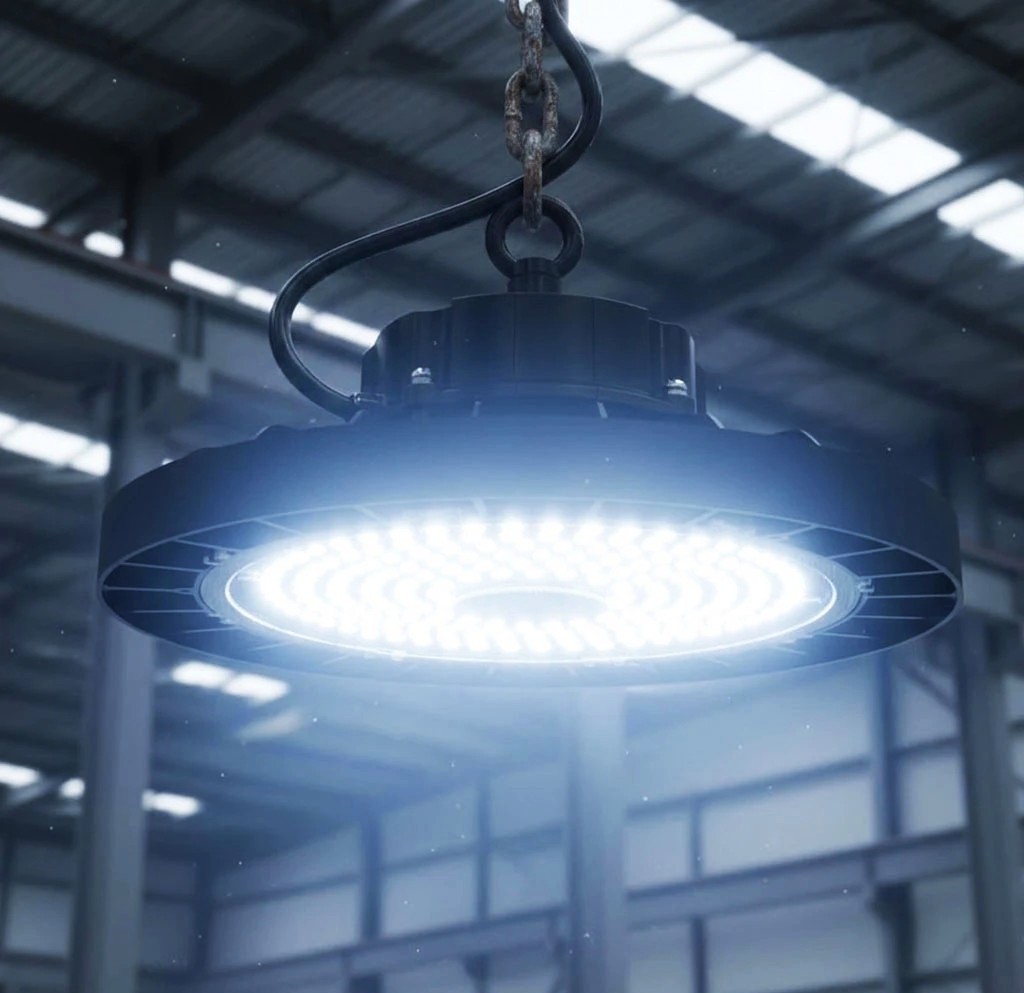
High bay LED lights 4000K produce a neutral white appearance that many facilities may find suitable for warehouse operations, workshops, and production spaces.
However, 4000K is not a universal requirement. A facility may need another color temperature depending on its tasks, visual environment, product inspection requirements, and preferences.
The important point is to maintain an intentional, consistent specification across the space.
Mixing different color temperatures in neighboring fixtures can create visible differences, particularly when workers look across a large open ceiling.
For environments where workers inspect colors or identify product defects, pay attention to CRI and other relevant color-quality data.
Color temperature alone does not tell you how accurately a source renders materials.
The designer should evaluate the complete lighting system rather than treating CCT as a shortcut for judging product quality.
INDUSTRIAL CONDITIONS (HEAT, DUST, MOISTURE, AND SAFETY)
A warehouse or factory can be hard on lighting equipment.
Dust accumulates on lenses and heat sinks, industrial processes may release particles into the air, and some areas experience moisture, cleaning sprays, or temperature extremes.
The fixture specification must reflect these conditions rather than simply use the same product throughout the building.
Correct IP Rating
An IP rating indicates the level of protection an enclosure provides against the ingress of solid objects and water under defined test conditions.
An IP rating does not prove that a fixture suits every industrial environment. It does not, by itself, establish resistance to all chemicals, corrosion, impact, high temperatures, or explosive atmospheres.
Choose the protection level based on the actual conditions.
A clean, controlled warehouse may need a different product from a workshop with airborne dust or a food-processing area where regular washdown takes place.
UAE Heat and Dust
For projects in the UAE, verify the fixture’s specified operating-temperature range and the conditions around the mounting point.
A warehouse may have air conditioning, while a factory roof zone or a poorly ventilated area may experience much higher temperatures.
Dust can also restrict airflow or accumulate on the fixture, affecting heat transfer and light output.
International LED reliability guidance discusses how temperature and thermal management affect the reliability of LED components and drivers. It is therefore worth reviewing the full luminaire specification rather than relying only on an advertised lifetime figure.
Specially Approved Fixtures for Hazardous Areas
Some facilities handle combustible dusts, flammable vapors, gases, or other materials that create special electrical risks.
Examples may include certain chemical processing areas, fuel operations, paint processes, or dust-producing industrial operations.
In these environments, a standard IP-rated high bay is not necessarily suitable.
The project may require luminaires specifically approved for the classified hazardous location and its actual risks.
IEC 60598-2-24 addresses luminaires designed with limited surface temperatures for certain combustible-dust risks, but its scope does not cover every explosive-gas or explosive-dust application.
The designer must, therefore, select equipment appropriate to the actual classification and applicable local rules.
HIGH BAY LED LIGHTS WITH MOTION SENSOR AND SMART CONTROLS
Lighting controls can reduce unnecessary operating time, especially in buildings where some areas remain unoccupied for long periods.
High bay LED lights with motion sensor capabilities can switch on or adjust their output when people enter a zone. Depending on the system, the controls may also support dimming or daylight response.
But sensor selection needs to follow how the space operates. A poorly positioned sensor may fail to detect movement between racks or keep turning lights off when a worker remains relatively still.
Sensor Settings That Fit Warehouse Operations
Consider the movement patterns of people, forklifts, and other equipment.
Sensor coverage should account for rack geometry, obstructions, mounting height, and the size of the controlled zone.
A system that dims to a lower output during vacancy may be more appropriate than switching completely off in some locations. The correct behavior depends on operational safety, local requirements, and the warehouse’s normal activity.
A documented warehouse lighting retrofit at Shiseido America combined LED fixtures with occupancy sensors.
The warehouse portion used 240 high-bay, aisle, and explosion-proof luminaires, and the project estimated annual savings of 230,000 kWh from its lighting upgrades.
That result illustrates the potential of integrated lighting and controls, but it does not guarantee the same savings in another facility.
Daylight Response and Dimming
Warehouses with skylights may receive enough daylight during parts of the day to reduce artificial lighting.
Daylight-responsive controls can adjust the lighting based on available natural light, provided the sensors, fixture drivers, and control system work together. This can reduce energy use while maintaining the intended illumination.
For facilities with varying occupancy, dimming and occupancy controls may also help manage energy use.
The savings depend on operating hours, existing equipment, sensor placement, control settings, and how the building is used.
LED WAREHOUSE LIGHTING INSTALLATION AND MAINTENANCE
Even a well-specified product can underperform when an installer positions it incorrectly or overlooks the manufacturer’s mounting requirements.
High-bay fixtures often sit above storage racks, conveyors, machinery, or active work areas. That makes installation planning and future service access particularly important.
Plan the Lighting Layout Before Installation
Start with an accurate floor plan, ceiling height, rack geometry, and the positions of machinery and workstations.
Use those details to prepare a lighting layout and calculate the proposed illumination.
The layout should show fixture locations, mounting methods, intended distribution, and relevant control zones.
Review it against the building’s electrical, structural, and operational requirements before installation begins.
For warehouse projects in Dubai, Abu Dhabi, or elsewhere in the UAE, confirm the relevant authority requirements and the applicable building or industrial development rules before finalizing the specification.
Check Product Safety and Technical Documentation
International standards provide useful benchmarks for product safety.
IEC 60598-1:2024 specifies general requirements and tests for luminaires, including electrical and mechanical construction, marking, and relevant safety considerations.
The DesignLights Consortium also maintains technical requirements for qualifying commercial LED luminaires, including performance testing and higher-performance criteria under its Premium classification.
Such qualifications can help buyers compare documented performance, but the buyer should verify the exact product and the requirements relevant to the project.
Establish a Maintenance Plan
LED products can operate for many hours, but that does not make them maintenance-free.
Dust buildup, lumen depreciation, driver failure, damaged wiring, and changes in the facility layout can affect performance over time.
Schedule inspections and cleaning according to the environment and the manufacturer’s guidance.
Also consider how maintenance teams will reach fixtures safely without creating unnecessary disruption to warehouse operations.
For large facilities, measuring light levels periodically can help identify areas that no longer meet their original requirements. A fixture replacement plan should take account of operating hours, access costs, and the consequences of lighting failure in critical work areas.
UAE REQUIREMENTS FOR WAREHOUSE AND FACTORY LIGHTING
Industrial lighting projects should follow applicable local requirements as well as the design standards specified by the project team.
In Abu Dhabi, ADOSH-SF Code of Practice 8.0, General Workplace Amenities, applies to employers within the emirate.
Its workplace lighting section specifies minimum illumination intensities for different area types, including a minimum of 5 foot-candles (approximately 54 lux) for listed areas such as warehouses and loading platforms.
This minimum should not be treated as a recommended target for every storage or production task, which may require higher illumination under the relevant design standard or process requirements.
The UAE Ministry of Human Resources and Emiratisation also sets workplace lighting expectations, including adequate illumination, attention to glare, suitable lighting for precision operations, and emergency lighting when the primary system fails.
For warehouses and industrial developments within the relevant Trakhees/PCFC jurisdiction, the published green building regulations include requirements for energy-efficient lighting and call for consideration of the specific process, storage, temperature, lumen output, efficacy, and color-rendering needs.
These provisions do not automatically apply to every project across the UAE; confirm the jurisdiction and applicable approvals.
HOW TO SELECT A HIGH BAY LED LIGHTS SUPPLIER?
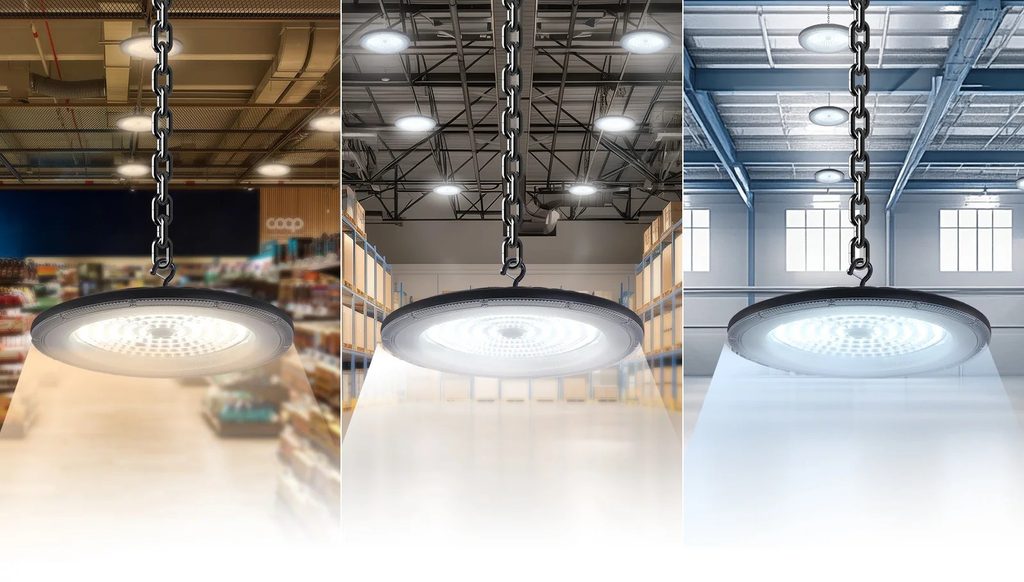
Choosing a high bay LED lights supplier should involve more than comparing unit prices.
The supplier should be able to provide clear technical data and help the project team select suitable products for the actual application.
Ask for the fixture’s wattage, lumen output, efficacy, color temperature, CRI, beam distribution, operating-temperature range, IP rating, and control compatibility.
Where needed, request photometric files and the documentation that demonstrates relevant safety and performance qualifications.
A supplier should also explain the mounting options, warranty, product lead time, maintenance considerations, and availability of replacement components.
For a large installation, consistency across the specified product batch can matter as much as the performance of one sample fixture.
Compare the Whole Project, Not Just the Unit Price
A lower-priced luminaire may reduce the initial purchase cost but deliver a different level of light, require more fixtures, or create more maintenance work.
Instead, compare the products against the same lighting layout and requirements.
Review the initial cost alongside estimated energy consumption, expected operating hours, maintenance access, and the cost of replacing fixtures or drivers.
The most economical choice is the one that meets the lighting requirements reliably over the project’s operating life, not necessarily the one with the lowest purchase price.
COST OF HIGH BAY LED LIGHTS IN UAE
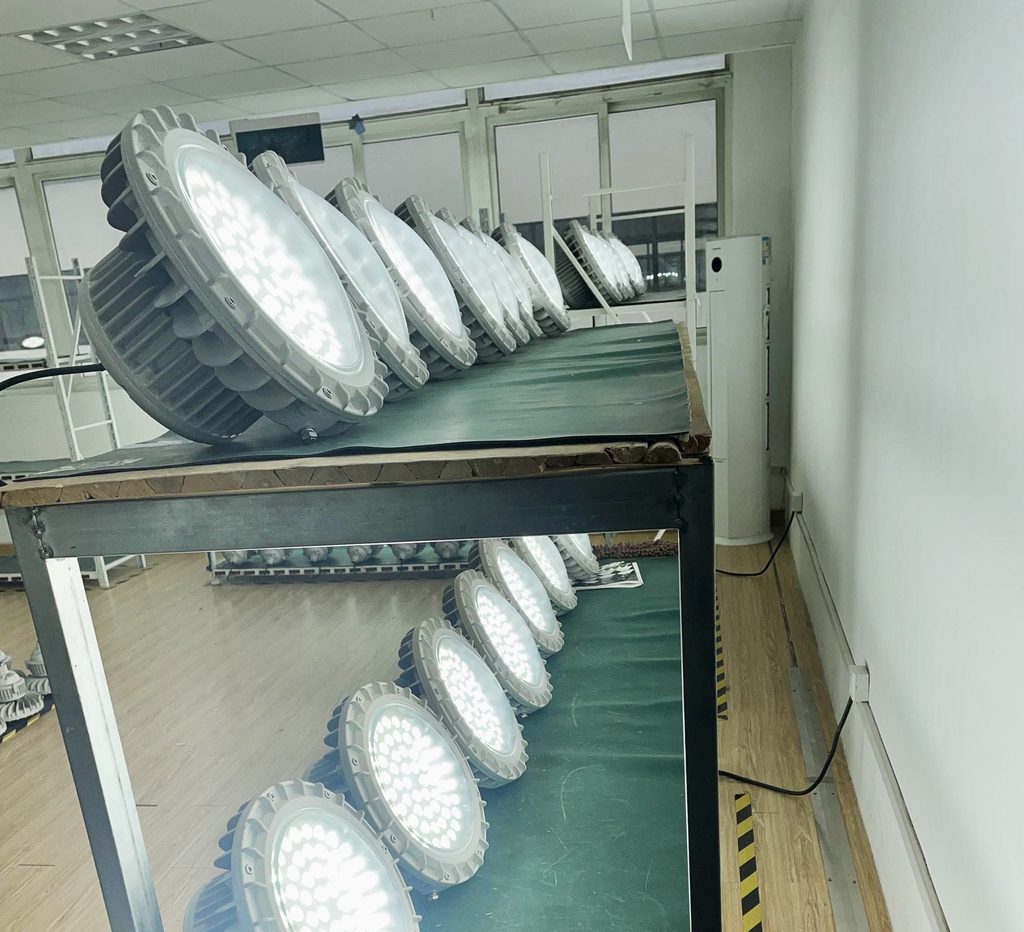
When budgeting for high bay LED lights in the UAE, it makes sense to look beyond the cheapest products on the market.
Commercial-grade fixtures with better construction, more reliable drivers, suitable protection ratings, and stronger warranties can cost considerably more than basic models.
For warehouses and factories, a reasonable starting point is to budget for the mid-to-upper end of the market, especially when the lights will operate for long hours or in demanding industrial conditions.
High Bay LED Lights Price Ranges by Wattage
The following figures are indicative UAE budgeting ranges for individual fixtures, leaning toward branded or higher-specification options rather than entry-level products.
- 100W high bay LED lights: AED 150–250 per fixture.
- 150W high bay LED lights: AED 200–300 per fixture.
- 200W high bay LED lights: AED 250–400 per fixture.
- 250W–320W high bay LED lights: AED 300–500 per fixture.
- 400W–500W high bay LED lights: AED 450–800 per fixture.
These are planning estimates, not fixed market prices. Current listings show substantial differences between basic models and more expensive branded options, even at similar wattages.
Why Do High Bay LED Light Prices Vary So Much?
Wattage alone does not determine the price.
Several technical and commercial factors can make one fixture substantially more expensive than another.
Fixtures with higher lumen output and better efficacy may cost more, particularly when they achieve the required performance with less electrical power.
Besides, industrial models designed for dusty, damp, hot, or demanding environments may use more robust housings and higher IP ratings.
We also shouldn’t forget component quality, thermal management, flicker performance, and documented product life can influence both price and long-term reliability.
How Much Should You Budget for LED Warehouse Lighting?
For a project involving dozens or hundreds of fixtures, the price difference between individual products can significantly affect the initial budget.
However, choosing the cheapest fitting does not necessarily reduce the total project cost.
A product with lower light output may require more fixtures, while an unsuitable beam angle may create dark areas that force the designer to revise the layout.
Request a lighting calculation based on the ceiling height, floor dimensions, rack arrangement, and required illumination.
Then compare quotations using the same lighting targets and product requirements.
Does the Price Include Installation?
The price ranges above cover the fixture itself, not a complete lighting installation.
Your final project budget may also include mounting accessories, cabling, electrical work, access equipment, lighting design, controls, and commissioning.
For large warehouses and factories, ask for a separate breakdown of product supply, installation, and any additional electrical work.
This makes it easier to compare quotations accurately and avoid unexpected costs.
FINAL THOUGHT
Choosing high bay LED lights for a warehouse or factory means balancing illumination, efficiency, product quality, and the real conditions inside the building.
UFO fixtures can work well in open areas, while linear high bays may suit aisles and long production zones.
As mentioned before, wattage categories such as 150W, 200W, 250W, and 500W help narrow a product search, but they cannot replace an actual lighting calculation.
The most useful starting point is the task. Identify the work being carried out, determine the required illumination, examine the mounting height and layout, then compare products using real technical data.
For UAE facilities, also check heat and dust conditions, applicable safety and building requirements, and whether controls can reduce operating time without compromising safe work.
A well-planned system can deliver more than brighter ceilings: it can create a more usable workspace, simplify maintenance, and manage energy more intelligently.
Related Posts
Track Lights in Dubai and Abu Dhabi: LED, Magnetic, and Mini Track Lights in 2027
DALI Lighting Systems in Dubai and Abu Dhabi: Supply, Installation, and Costs in 2027
Custom Chandeliers in Dubai and Abu Dhabi: For Villas, Hotels, and Luxury Spaces in 2027
Decorative LED Panel Light: A Complete Buying Guide in UAE
LED Office Light Fixtures for Corporate Offices and Businesses in Dubai and Abu Dhabi
Square Led Ceiling Light Fixture in UAE: A Complete Buying Guide in 2027