
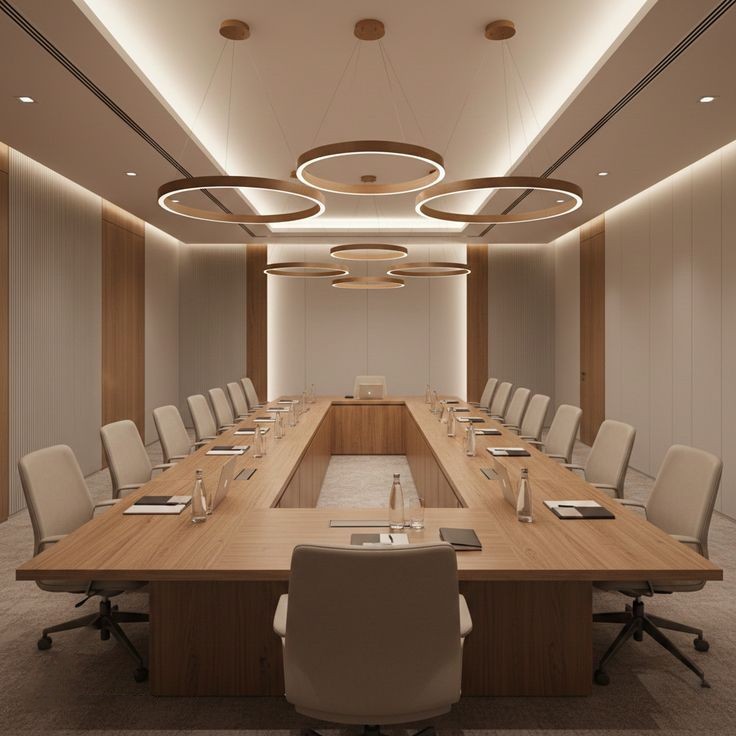
LED Office Light Fixtures for Corporate Offices and Businesses in Dubai and Abu Dhabi
Choosing lighting for a corporate office sounds straightforward until you start looking at the details.
You need enough light for people to work comfortably, fixtures that complement the interior design, and a system that does not waste energy throughout the working day.
At the same time, the lighting should reflect the quality of your business, whether you are fitting out a new office in Dubai, renovating a corporate headquarters in Abu Dhabi, or developing an entire commercial building.
That is where LED office light fixtures become important.
Modern LED luminaires offer considerable flexibility in their design, light distribution, energy performance, and control options.
But choosing the right products involves more than replacing old fluorescent lights with LEDs.
You need a lighting solution that considers the actual work being performed, the layout of the office, the current office ceiling lights or design, daylight, computer screens, and the way different spaces are used.
For many businesses in the UAE, these decisions deserve particular attention by a lighting consultant.
Offices often combine large, glazed facades, open-plan workstations, private offices, meeting rooms, reception areas, and shared spaces. Each has different lighting needs.

PROFESSIONAL OFFICE LIGHTING IN DUBAI AND ABU DHABI
A well-lit office should do more than make desks visible.
It should help people carry out their work comfortably while supporting the architecture, furniture, and overall identity of the business.
Walk into a thoughtfully designed corporate office and you may not immediately notice the lighting fixtures themselves.
Instead, you notice the atmosphere, right?
The reception looks welcoming, the meeting rooms feel comfortable, the workstations are clearly illuminated, and the hanging lights for office appear clean and well organized.
Achieving that result takes planning, however.
Professional office lighting begins with understanding the different activities that take place throughout the building.
A workstation used for computer-based work has different requirements from a reception desk, a conference room, a technical drawing area, or a break room.
The selected luminaires must provide suitable illumination for each task while controlling glare, reflections, and distracting brightness differences.
Their appearance also needs to work with the interior design, whether the office uses suspended ceilings, recessed lighting, exposed services, linear fixtures, or decorative pendants.
In Dubai and Abu Dhabi, corporate offices may include several distinct environments within the same property.
Open-plan offices generally require coordinated lighting across multiple workstations. The objective is to provide appropriate illumination without creating uncomfortable brightness differences or distracting reflections on computer displays.
Private offices may need a combination of general lighting, task lighting, and softer illumination for meetings or focused work.
Conference rooms often require more flexible lighting. A room used for presentations, video conferences, and collaborative discussions benefits from lighting that can adapt to these different activities.
Reception areas and executive offices introduce another consideration: appearance. Here, architectural lighting, decorative pendants, and carefully positioned accent lights can contribute to the company’s professional image without compromising visual comfort.
Corridors, lift lobbies, and shared areas require a consistent approach to visibility, wayfinding, and the overall atmosphere of the building.
A single fixture type may be appropriate for several areas, but it should not be assumed that one lighting arrangement will suit every room.
WHY PROFESSIONAL OFFICE LIGHTING DESIGN?
The Illuminating Engineering Society’s Recommended Practice: Lighting Office Spaces, published as ANSI/IES RP-1-24, covers lighting quality, colour, flicker, sustainability, maintenance, lighting controls, illuminance, glare, and the requirements of different office areas.
These principles are useful when developing a lighting specification for a corporate workplace.
They encourage designers to consider the complete visual environment instead of judging the installation by brightness alone.
For a large office project, this means reviewing the architectural plans, ceiling heights, workstation positions, surface finishes, daylight conditions, and lighting controls before choosing the final products.
A coordinated approach also helps identify potential problems early. A fixture might be visually attractive but unsuitable for the ceiling system.
A lighting arrangement might create unwanted screen reflections. Or a design might provide too much light in one area while leaving another insufficiently illuminated.
The earlier these issues are identified, the easier it is to address them.

LED OFFICE LIGHTING DESIGN AND FIXTURES
LED technology is now widely used in commercial lighting because it offers flexibility in light output, fixture design, energy consumption, and control.
However, LED is a light-source technology, not a guarantee that a particular luminaire will be suitable for an office.
Two LED fixtures can consume similar amounts of electricity while producing different light distributions, colour quality, glare performance, and overall results.
That is why selecting office lighting should begin with the application, followed by the technical specifications and the fixture’s physical design.
LED Panel Lights for Offices
LED panel lights are commonly used in offices with suspended grid ceilings.
Their broad luminous surfaces can provide general illumination across open work areas, depending on the optical design and layout.
Panels are available in different sizes, shapes, outputs, and installation formats.
Some are recessed into the ceiling grid, while others are designed for surface mounting or suspension.
When evaluating an LED panel, check its actual lumen output, power consumption, light distribution, colour temperature, colour rendering, and glare data where available.
A panel with a high light output is not automatically the best choice. Its suitability depends on how it is arranged, the height of the ceiling, the reflectance of the room surfaces, and the visual tasks taking place below it.
For corporate offices, the objective is to achieve appropriate light levels and a comfortable visual environment, rather than installing the brightest panel available.
Linear LED Office Fixtures
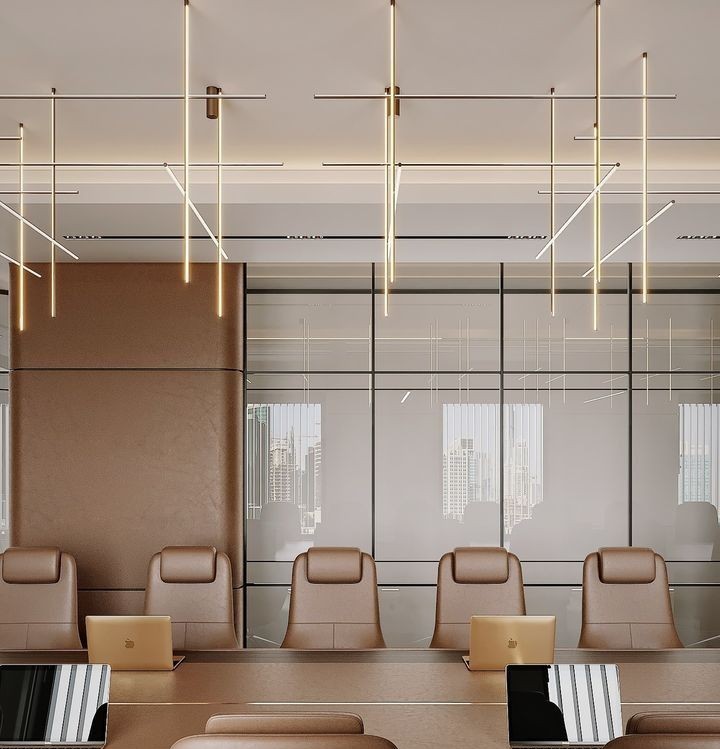
Linear LED luminaires are particularly useful in contemporary office interiors because their long, narrow forms can work with the geometry of desks, circulation routes, and architectural ceilings.
They can be recessed, surface-mounted, or suspended. Depending on the product, they may provide direct illumination towards the work plane, indirect illumination towards the ceiling, or a combination of both.
Linear systems can also create visual continuity across an open-plan workplace. When coordinated with the ceiling grid and workstation arrangement, they can make the office appear more organized.
However, the layout needs to be considered carefully. A continuous row of linear fixtures positioned directly above computer screens may introduce reflections or glare if the optical design and placement are unsuitable.
Professional lighting design helps determine the appropriate orientation, spacing, output, and distribution for the space.
LED Downlights and Recessed Office Fixtures
LED downlights are useful where a discreet ceiling appearance is desired. They are frequently considered for private offices, corridors, meeting rooms, reception areas, and circulation spaces.
Their performance depends on more than their size and wattage. Beam angle, shielding, optical design, glare, mounting depth, and spacing all influence the result.
For example, closely spaced downlights can create unnecessary brightness on the ceiling while still producing uneven illumination across desks. Conversely, a carefully planned arrangement may provide comfortable general lighting with fewer visible fixtures.
Recessed fittings must also be compatible with the ceiling construction, available installation depth, access requirements, and electrical provisions.
In modern corporate interiors, the best result often comes from combining suitable downlights with linear or indirect lighting, rather than expecting one fixture type to handle every lighting task.
Pendant and Direct-Indirect Luminaires
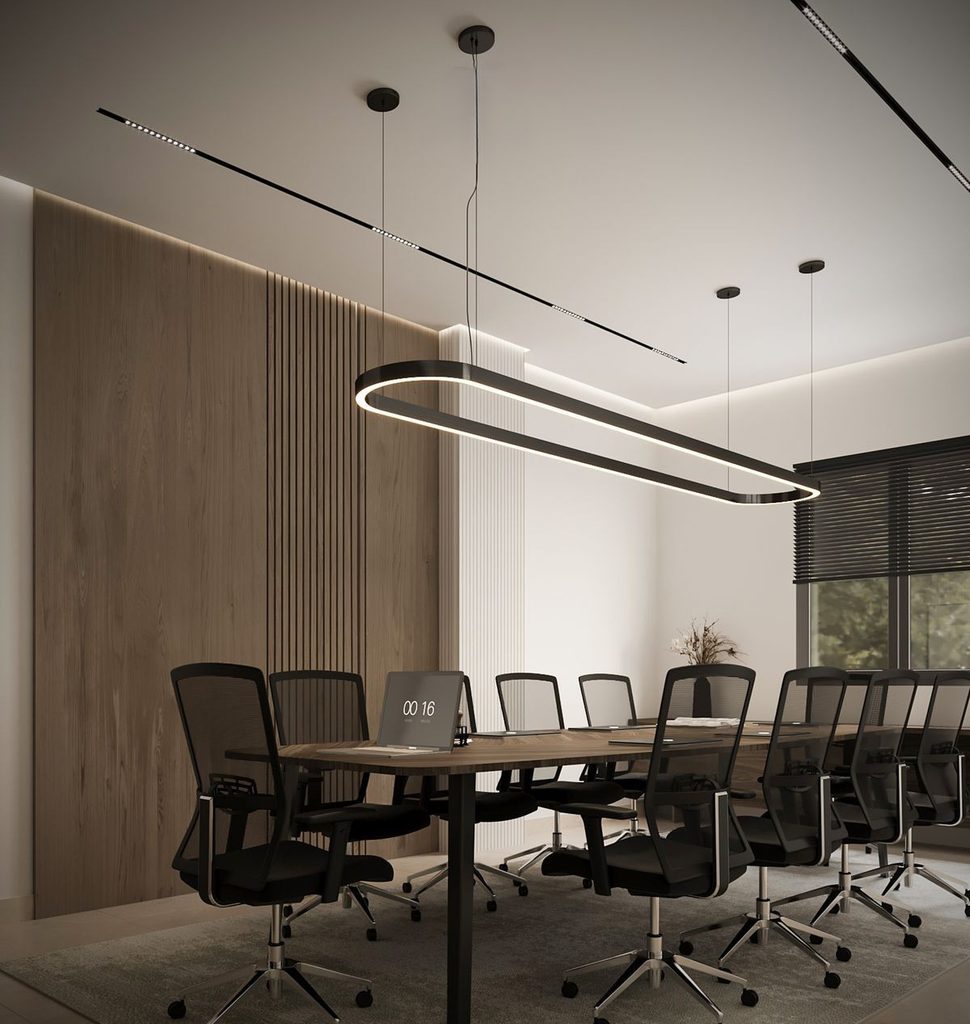
Suspended LED office fixtures can be particularly useful in offices with exposed ceilings, higher floor-to-ceiling heights, or a strong architectural design concept.
Many professional pendant luminaires combine direct light towards the workspace with indirect light directed towards the ceiling.
The indirect component can help brighten the ceiling and surrounding surfaces, contributing to a more balanced visual environment. The direct component provides illumination where work takes place.
The proportions and distribution of these two components depend on the specific product and lighting design.
Zumtobel’s published office projects illustrate this approach.
Its lighting solutions for workplaces in Dubai and Abu Dhabi include combinations of linear luminaires, controlled direct and indirect light, architectural lighting, and lighting-management systems.
These examples demonstrate that office lighting can be integrated into the building’s architecture while addressing practical workplace requirements.
SMART AND DIMMABLE OFFICE LIGHTING SYSTEMS
An office rarely needs exactly the same lighting throughout the working day.
Morning daylight can differ from midday conditions. A meeting room used for a presentation has different needs from one used for a collaborative workshop.
Some areas may remain occupied late in the evening, while others are empty for long periods.
This is where lighting controls can make a meaningful difference.
Rather than operating every fixture at a fixed output, a well-designed system can adjust lighting according to occupancy, daylight, working activities, and user preferences.
Dimmable LED Office Lighting
Dimmable fixtures allow the light output to be adjusted rather than simply switched on or off.
In meeting rooms, different lighting scenes can support presentations, discussions, and video conferences. Reception areas may use different levels for daytime and evening operation. Individual offices may benefit from adjustable lighting where the system permits it.
However, not every LED fixture is dimmable, and not every dimmable fixture works with every control device.
Before purchasing, confirm the compatibility of the luminaire, LED driver, dimmer, and control protocol.
Products may support DALI, compatible phase-cut dimming, or other specified systems, while some are designed for fixed-output operation.
For larger commercial projects, these requirements should be established during the design and specification stage.
Occupancy Sensors and Automatic Controls
Occupancy sensors can switch lights off or reduce their output when areas are unoccupied, depending on the control system.
This can be useful in meeting rooms, storage areas, washrooms, and other spaces where occupancy varies.
Daylight sensors offer another option. By monitoring available daylight, they can help adjust electric lighting near windows or skylights, maintaining the intended lighting conditions while reducing unnecessary output.
Dubai Electricity and Water Authority recommends efficient lighting, using daylight where appropriate, switching off lights in unoccupied areas, and applying timers, motion detectors, and dimmers where suitable.
The exact benefits of these controls depend on the building, its operating schedule, commissioning, and how the system is used.
LIGHTING MANAGEMENT FOR LARGE OFFICES
For a corporate headquarters or multi-floor office building, centralized lighting management may be worth considering.
Depending on the system, it can provide scheduled operation, daylight-responsive control, occupancy detection, dimming, and predefined lighting scenes.
Such functions can help facility managers manage a large number of luminaires more consistently.
They also make it easier to adapt the lighting when office layouts change. For example, a business may reorganize its open-plan seating, change a meeting room’s function, or introduce different working hours.
These possibilities are worth discussing with the lighting designer and electrical consultant before selecting the controls.
A technically advanced system is only useful when its functions are appropriate for the building and straightforward for the people who operate it.
LIGHTING QUALITY, COLOR, AND FLICKER
A room can have enough light on paper and still feel uncomfortable.
The reason is that lighting quality involves several interacting factors: colour appearance, colour rendering, flicker, brightness distribution, reflections, and the way the fixture illuminates the surroundings.
When selecting LED office light fixtures, these characteristics deserve as much attention as energy efficiency and appearance.
Choosing the Right Colour Temperature
Correlated colour temperature (CCT), measured in kelvins, describes whether the light appears relatively warm or cool.
Common options include 3000 K, 3500 K, and 4000 K, although many other values are available.
3000 K produces a warmer appearance and may suit reception areas, hospitality-inspired corporate interiors, and selected executive spaces where atmosphere is important.
3500 K offers an intermediate appearance that can suit some contemporary workplaces, depending on the interior design and surrounding finishes.
4000 K produces a more neutral-white appearance and is commonly considered for general office environments.
These are starting points rather than universal rules. The final choice should reflect the task, materials, daylight, visual preferences, and lighting strategy.
Colour temperature should also be coordinated across adjacent areas. A sudden, unplanned change between very different colour temperatures can make connected spaces feel inconsistent.
For a large office development, establishing a colour-temperature strategy before ordering the luminaires can help maintain consistency across departments, meeting spaces, corridors, and shared areas.
Colour Rendering and CRI
The colour rendering index (CRI) describes how accurately a light source renders colours compared with a reference illuminant under specified test conditions.
This matters when the appearance of materials and colours is important, such as in design studios, presentation rooms, retail offices, and reception areas.
A CRI of 80 or higher is commonly available in office lighting products, while some professional luminaires provide higher colour-rendering performance.
The correct specification depends on the application. It is worth reviewing the manufacturer’s published CRI and related colour-quality data instead of assuming that all LED fixtures render colours equally well.
Why Flicker Should Be Considered?
Flicker refers to fluctuations in light output over time. These fluctuations may not always be obvious to the eye, but their characteristics can matter in lighting quality and visual comfort.
LED performance depends partly on the driver and its interaction with the electrical supply and control system.
When choosing fixtures for a corporate office, ask manufacturers or suppliers for relevant flicker-performance information. Where appropriate, review published measures such as short-term flicker indicators and other documented performance data.
This is particularly worth considering in workplaces where employees spend long periods under artificial lighting or where light-sensitive visual tasks are performed.
Avoid relying solely on a generic description such as “flicker-free” without supporting technical information.
A reliable specification should identify the actual product and relevant measured performance rather than relying only on marketing terminology.
ILLUMINANCE, LUMINANCE, AND GLARE CONTROL
These terms may sound technical, but they help explain why some offices feel comfortable and others do not.
Illuminance describes the amount of light falling on a surface and is measured in lux.
Luminance describes the brightness of a surface or the apparent brightness of a source in a particular direction.
Glare occurs when brightness, contrast, or reflections create visual discomfort or interfere with seeing clearly.
All three are important when specifying LED office lighting fixtures.
How Much Light Does an Office Need?
The appropriate illuminance depends on the visual task and the type of workspace.
A desk used for reading documents and detailed work may require a different lighting arrangement from a corridor or reception area.
Meeting rooms may need flexibility for presentations and screen-based discussions.
There is no single illuminance figure that should be applied indiscriminately throughout an entire office building.
The Illuminating Engineering Society’s office-lighting guidance covers illuminance, luminance, uniformity, individual preferences, and glare.
It also addresses different office settings, including open-plan offices, private offices, conference rooms, and public areas.
For projects in Dubai and Abu Dhabi, the lighting designer should determine the appropriate targets using the applicable project requirements and relevant standards.
This should include the work plane, room geometry, lighting distribution, and intended use.
A lighting calculation can then help establish whether the proposed fixture arrangement will meet those objectives.
Glare in Computer-Based Workplaces
Glare is one of the main issues to consider when choosing office luminaires.
A bright LED source may be efficient and visually attractive, but if it is poorly shielded or positioned, it can create discomfort for people looking towards it.
Reflections from a luminaire can also appear on computer screens or other glossy surfaces.
These problems depend on the luminaire’s optical design, brightness, position, viewing angle, and the geometry of the room.
The Unified Glare Rating (UGR) is one method used to assess discomfort glare in indoor lighting.
ERCO’s technical guidance explains how the result depends on factors such as the luminaire’s light distribution, the arrangement of the fittings, room surface reflectances, and the observer’s position.
A UGR value is not simply a fixed characteristic of a product in every installation.
It should be evaluated in the context of a specified arrangement and viewing conditions.
For typical office activities, designers commonly assess whether the light installation satisfies the relevant glare criteria, including those specified by applicable workplace-lighting standards.
Reflections, Screen Placement, and Lighting Layout
The location of the light can matter as much as the light itself.
A downlight placed directly above a glossy work surface or in a problematic position relative to a display can create unwanted reflections.
A pendant with insufficient glare control may become distracting when someone looks up from a desk.
Possible solutions include using suitable optics, adjusting fixture positions, changing the orientation of linear luminaires, and coordinating the lighting with desk layouts and monitor positions.
Indirect lighting can also help illuminate walls and ceilings, reducing the contrast between a task area and its surroundings.
However, it must be designed carefully because indirect light alone may not provide the required illumination on the work plane.
For this reason, the best office lighting design often combines suitable direct lighting with indirect or surrounding illumination.
The objective is not to eliminate every shadow or create uniform brightness everywhere.
It is to provide a comfortable visual environment that supports the work being performed.

OFFICE LIGHTING DESIGN FOR DIFFERENT WORKSPACES
Different departments use an office in different ways.
A practical lighting strategy accounts for those differences instead of treating the entire building as one large room.
Open-Plan Offices
Open-plan areas often contain rows of desks, shared workstations, circulation routes, and informal collaboration areas.
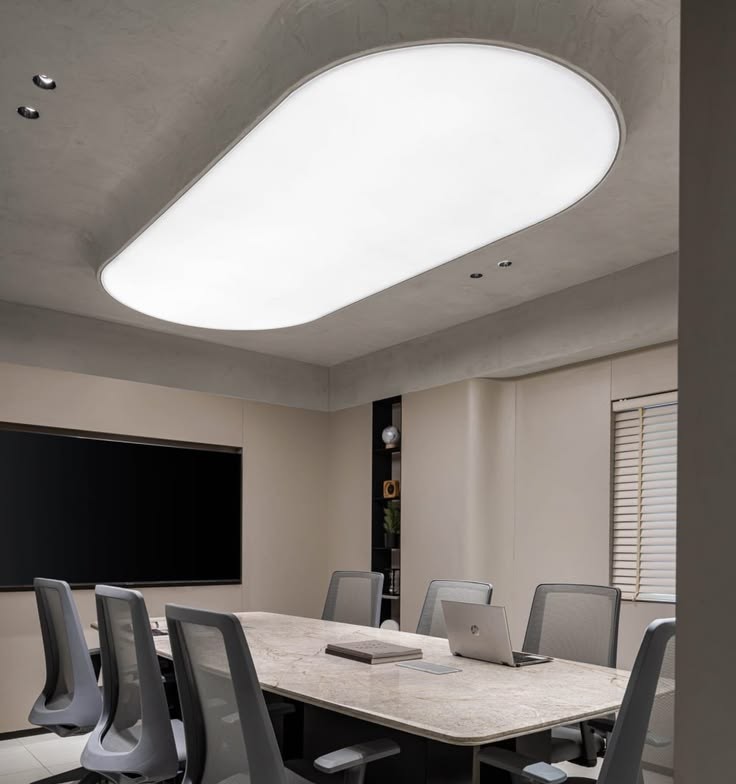
LED panels and linear luminaires can both be suitable, provided that their light distribution and spacing are carefully planned. The same thing applies to stretch ceilings.
Consideration should be given to desk orientation, computer displays, daylight, uniformity, and opportunities for local or individual control.
The arrangement should also be flexible enough to accommodate changes in the workstation layout without compromising the lighting quality.
Private Offices and Executive Rooms
Private offices often combine computer work, reading, meetings, and informal conversations.
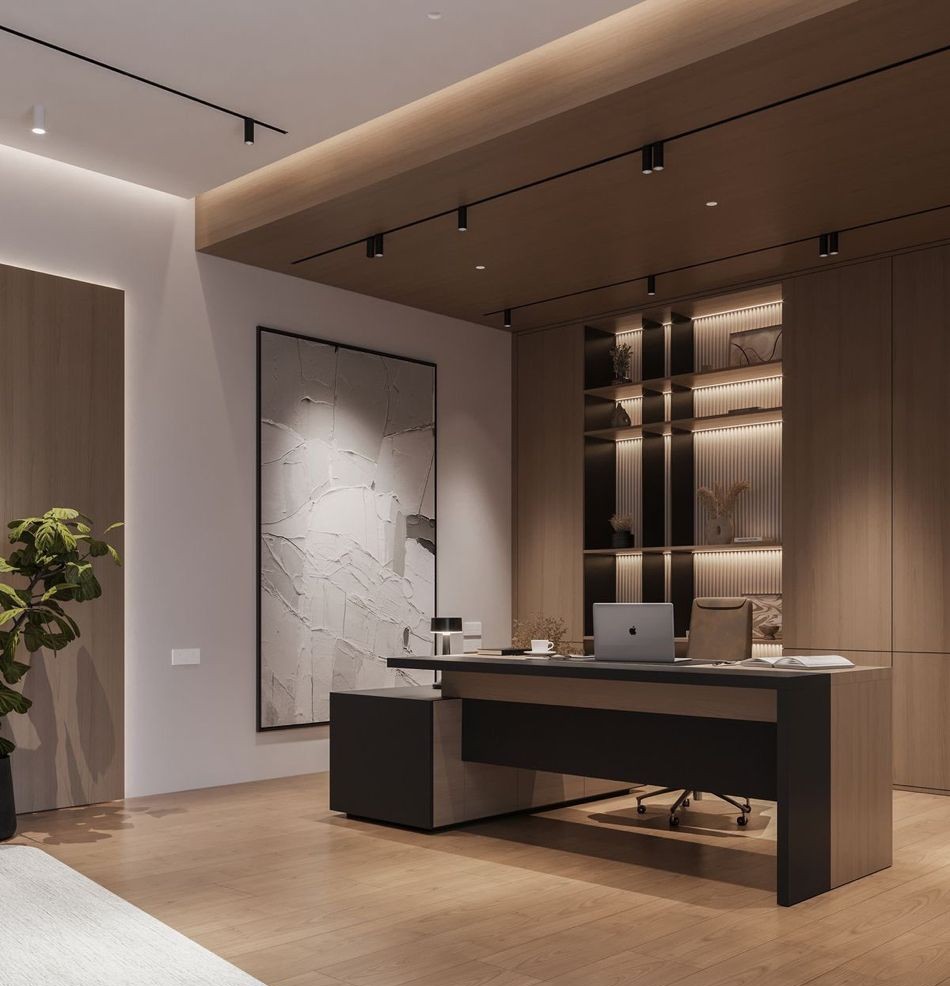
A layered approach can combine general ceiling lighting with suitable task or accent lighting. Dimmability may also be valuable where different activities require different lighting levels.
In executive rooms, the luminaires and their placement should complement the interior architecture and furniture without introducing excessive glare or distracting reflections.
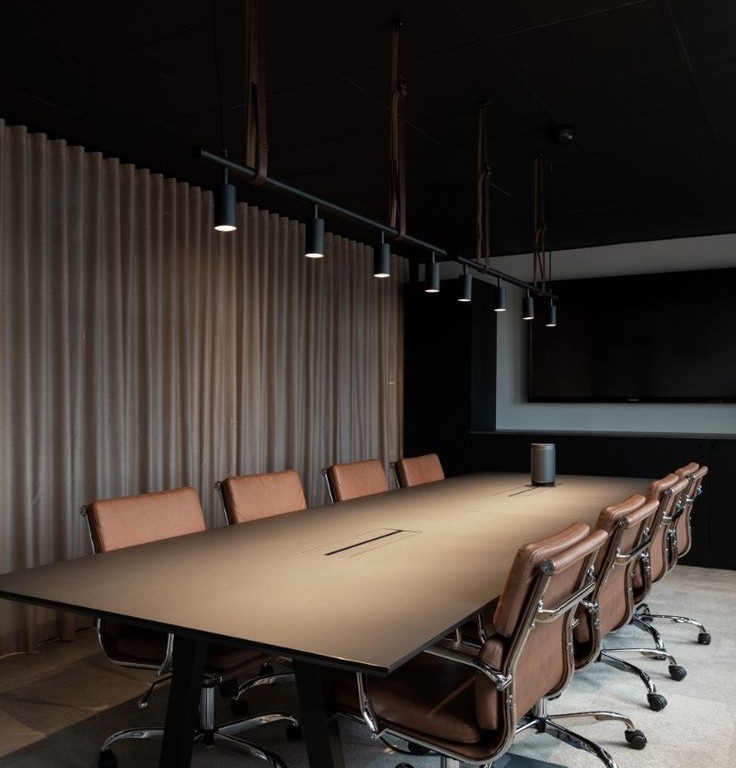
Conference Rooms and Video Meetings
Meeting rooms are particularly sensitive to lighting placement because people may need to read documents, use laptops, view presentations, and appear clearly on camera.
The system should provide suitable light on faces and work surfaces while limiting screen reflections.
Dimming and scene controls can allow users to move between presentation mode, discussion mode, and video conferencing.
The best arrangement depends on the room’s dimensions, screen position, ceiling height, and lighting equipment.
A design that works well for a small meeting room may not suit a large boardroom.
Reception Areas and Corporate Lobbies
The reception area often forms the first impression of a business.
Lighting can help define the reception desk, illuminate company branding, highlight materials, and create a welcoming entrance.
Linear luminaires, recessed downlights, decorative pendants, and wall lighting can all play a role, but the combination should follow the architectural concept.
A reception area may benefit from more decorative lighting than a typical workstation zone. However, decorative impact should not come at the expense of comfortable illumination or clear wayfinding.
Corridors, Support Areas, and Shared Facilities
Corridors, storage rooms, print areas, kitchens, and other shared facilities have different operational requirements from desk-based workspaces.
These areas may benefit from straightforward, efficient lighting and automatic controls where appropriate.
A consistent approach to colour temperature and fixture appearance can help the building feel coordinated, while different light distributions can address the needs of individual rooms.
Emergency lighting must also be considered as a separate life-safety requirement, using suitable equipment and an installation that meets the applicable local requirements.
SUSTAINABILITY, MAINTENANCE, AND LIGHTING CONTROLS
For businesses in Dubai and Abu Dhabi, the cost of office lighting extends beyond the initial purchase.
Electricity use, maintenance access, replacement components, operating schedules, and the ability to control light output can all affect the cost of ownership.
LED lighting can reduce energy consumption compared with less efficient lighting technologies, but the result depends on the products selected and the way the system is designed and operated.
Comparing Energy Performance
When comparing luminaires, examine both power consumption and light output.
Wattage indicates electrical power consumption.
Lumens indicate the quantity of visible light produced.
Luminous efficacy, expressed in lumens per watt, indicates how efficiently a product produces light.
However, a high efficacy rating does not automatically make a luminaire the best choice for a particular office.
The distribution of the light, its glare performance, the installation layout, and the amount of light required all affect the overall result.
A suitable luminaire can help avoid excessive installed power while still providing the necessary illumination.
For a large office, lighting calculations should evaluate the proposed system as a whole rather than simply adding together the nominal output of individual fixtures.
Daylight and the UAE Climate
Daylight is an important consideration in many modern offices, especially those with large windows or glazed facades.
However, the amount and direction of daylight can change significantly throughout the day.
Direct sunlight may also produce reflections on computer screens or create uneven brightness across a workspace.
In Dubai and Abu Dhabi, the design should consider the relationship between daylight, shading, blinds, air conditioning, and electric lighting.
Zumtobel’s published office projects in the UAE discuss these challenges, including the management of daylight and screen glare in Dubai and integrated lighting solutions at the Siemens headquarters in Abu Dhabi.
Daylight-responsive controls may help reduce artificial lighting when sufficient daylight is available.
Their effectiveness depends on sensor placement, commissioning, blinds, occupancy patterns, and the overall control strategy.
Maintenance and Useful Life
For offices with hundreds or thousands of luminaires, maintenance can become a substantial operational consideration.
When evaluating products, check the manufacturer’s stated useful life and the conditions under which it is specified.
Review warranty coverage, driver availability, replaceable components, cleaning requirements, and access for maintenance.
LED useful-life claims should not be interpreted simply as a guarantee that every component will operate indefinitely.
Light output can decline over time, and drivers or other electronic components may require attention.
A well-planned installation makes maintenance easier by providing suitable access and by using products with clear documentation and support arrangements.
For corporate facilities, choosing reliable fixtures and planning maintenance from the beginning can help the lighting system remain consistent throughout its service life.
HOW TO CHOOSE LED OFFICE LIGHT FIXTURES FOR A CORPORATE PROJECT IN UAE?
Selecting the final fixtures becomes easier when the decision follows a clear sequence.
Define the Lighting Requirements
Start by identifying the function of each space, the visual tasks involved, the working hours, and the intended atmosphere.
Establish appropriate illuminance targets, colour quality, glare criteria, and any special requirements for screens, presentations, or detailed work.
Review the Ceiling and Architecture
Confirm the ceiling type, mounting method, installation depth, available access, and the positions of building services.
The lighting should work with the architecture rather than forcing unnecessary changes late in the project.
Compare Technical Specifications
Request the relevant data sheets, photometric files, electrical details, driver information, glare data, warranty terms, and installation instructions.
Where products are being compared, review their actual performance rather than relying on marketing names or nominal wattage.
Prepare a Lighting Layout
The layout should show the proposed fixture positions and account for desks, meeting tables, partitions, walls, and circulation routes.
For a detailed project, lighting calculations and simulation can help assess light levels, uniformity, and glare before installation.
Plan Controls and Commissioning
Decide whether dimming, occupancy detection, daylight response, scheduled operation, or centralized controls are needed.
Confirm compatibility among luminaires, drivers, sensors, and the selected control system.
The installed system should then be tested and commissioned to verify that its operation matches the design intent.
Consider Supply, Installation, and Long-Term Support
For property developers who handle large corporate offices, it can be valuable to coordinate lighting design, product supply, installation, and commissioning.
This is where complete packages focused on lighting design for property developers come in handy.
This provides a clearer basis for checking that the delivered products match the specifications and that the finished system performs as intended.
For businesses fitting out new offices or renovating existing premises in Dubai and Abu Dhabi, Blink Lighting offers professional lighting design, fixture supply, and installation services.
A coordinated approach can help businesses evaluate the options before purchasing products and proceeding with the installation.
FINAL THOUGHT
Choosing LED office light fixtures for a corporate office in Dubai or Abu Dhabi is not simply a matter of selecting attractive fittings or replacing old lamps with newer technology.
The best result comes from combining appropriate illuminance, visual comfort, colour quality, energy performance, glare control, suitable controls, and a layout that reflects the way the workplace is used.
LED panels, linear luminaires, recessed downlights, and suspended fixtures all have their place.
The correct choice depends on the space, the ceiling, the visual tasks, and the intended appearance of the office.
For larger projects, professional lighting design allows these decisions to be evaluated together.
It can help identify issues with glare, fixture spacing, ceiling coordination, and lighting controls before they become installation problems.
The aim is simple: create a workplace where the light does its job comfortably, the architecture looks considered, and the system is practical to operate and maintain.
If your business is planning a new office, corporate headquarters, or commercial fit-out in Dubai or Abu Dhabi, start with a clear lighting plan. The right fixtures come next.


Related Posts
Square Led Ceiling Light Fixture in UAE: A Complete Buying Guide in 2027

