
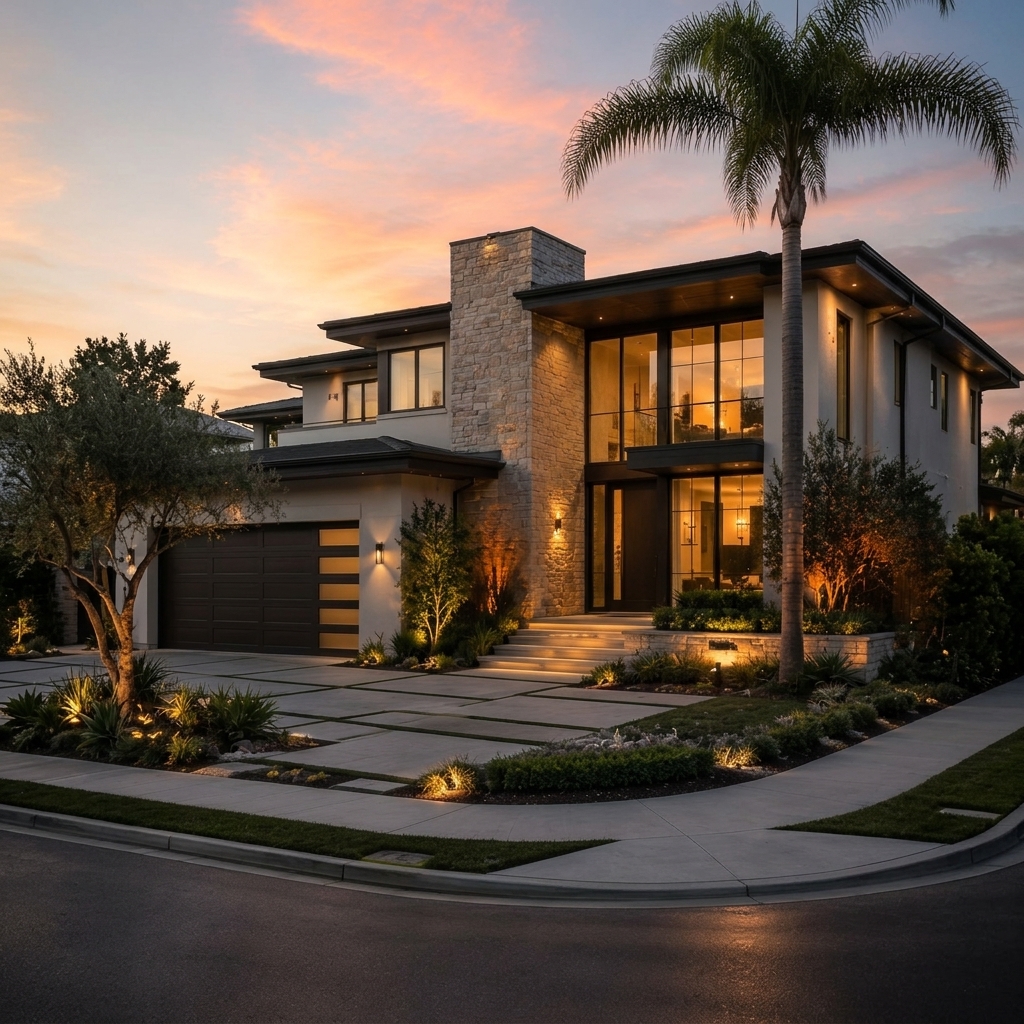
Facade Lighting in Dubai and Abu Dhabi for Villas and Homes
Sometimes, the architecture at night seems even more impressive than it does during the day.
The stone looks richer, the entrance feels more welcoming, and the building appears to have a depth that wasn’t as obvious in daylight.
That effect isn’t simply about making the exterior or facade brighter.
It’s about deciding which parts of the architecture deserve attention, how the light should reach them, and what should remain in shadow.
Facade lighting in Dubai and Abu Dhabi often combines architecture, lighting technology, and visual composition to reveal a building’s form after dark.
A lighting consultant considers wall materials, architectural details, fixture positions, and color temperature and glare when designing the facade’s light.
In the UAE, these decisions are especially relevant to luxury villas and high-end residential properties.
Contemporary homes often feature natural stone, textured finishes, glass, decorative screens, recessed entrances, and carefully designed landscaping.
Each material responds differently to light, so an arrangement that works beautifully on one surface may look harsh or uneven on another.
A successful facade lighting, which is an essential part of villa lighting design, should enhance the architecture without overwhelming it.
It should also account for energy use, maintenance, outdoor exposure, and local requirements governing exterior illumination.
This guide explains the techniques, products, and planning decisions that help create effective facade lighting for villas and homes in Dubai, Abu Dhabi, and across the UAE.
BUILDING FACADE LIGHTING IN DUBAI AND ABU DHABI
The first decision in building facade lighting design is not which fixture to buy. It’s deciding what the building should look like at night.
Some homes benefit from a calm, uniform appearance, while others need carefully placed accents that emphasize columns, recessed entrances, textured walls, or projecting architectural elements.
The appropriate approach depends on the building’s form, materials, and surroundings.
The Right Light Distribution
Light distribution describes how a luminaire directs light toward the surface.
Often, this requires 3D lighting design that involves simulations or visualizations.
It has a major influence on the finished appearance, regardless of the fixture’s wattage.
Narrow beams can emphasize relatively small architectural details, while wider beams cover larger areas.
Specialized wallwash optics are designed to create a more uniform distribution across vertical surfaces.
For example, a narrow-beam spotlight may be suitable for emphasizing an individual column or architectural detail.
Using that same beam repeatedly across a broad wall, however, could create distracting patches of brightness.
The fixture should be selected for the surface and the intended effect, rather than simply for its appearance.
Uniform Illumination Across the Facade
Wallwashing illuminates the surface relatively evenly, allowing the overall shape and composition of the building to remain visible after sunset.
This can work particularly well on broad exterior walls, smooth plaster, and architectural surfaces where the overall form matters more than individual textures.
Uniform illumination does not necessarily require high light levels.
A carefully controlled scheme can make a vertical surface appear visually prominent without producing excessive brightness.
Grazing Light to Reveal Material Texture
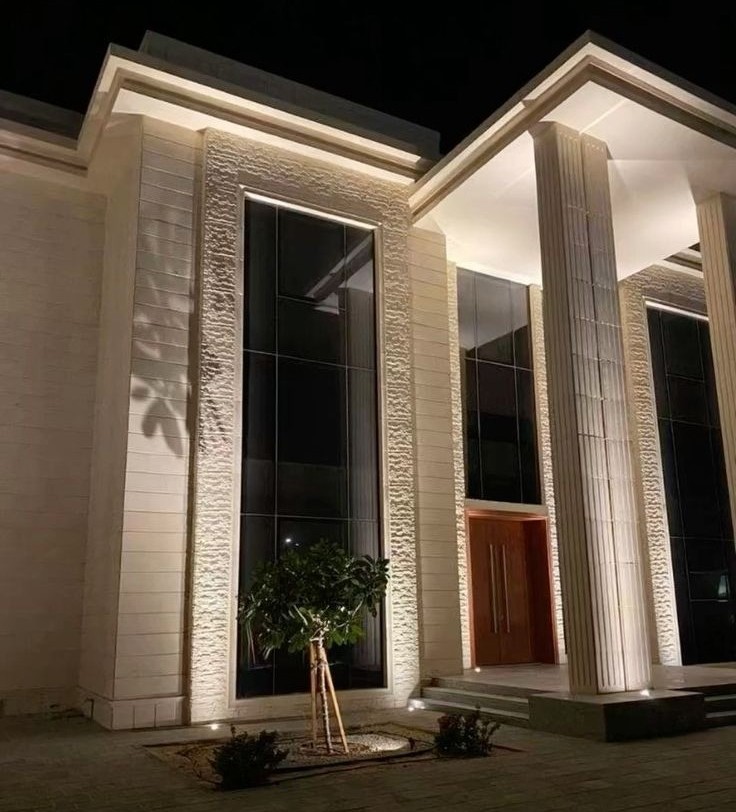
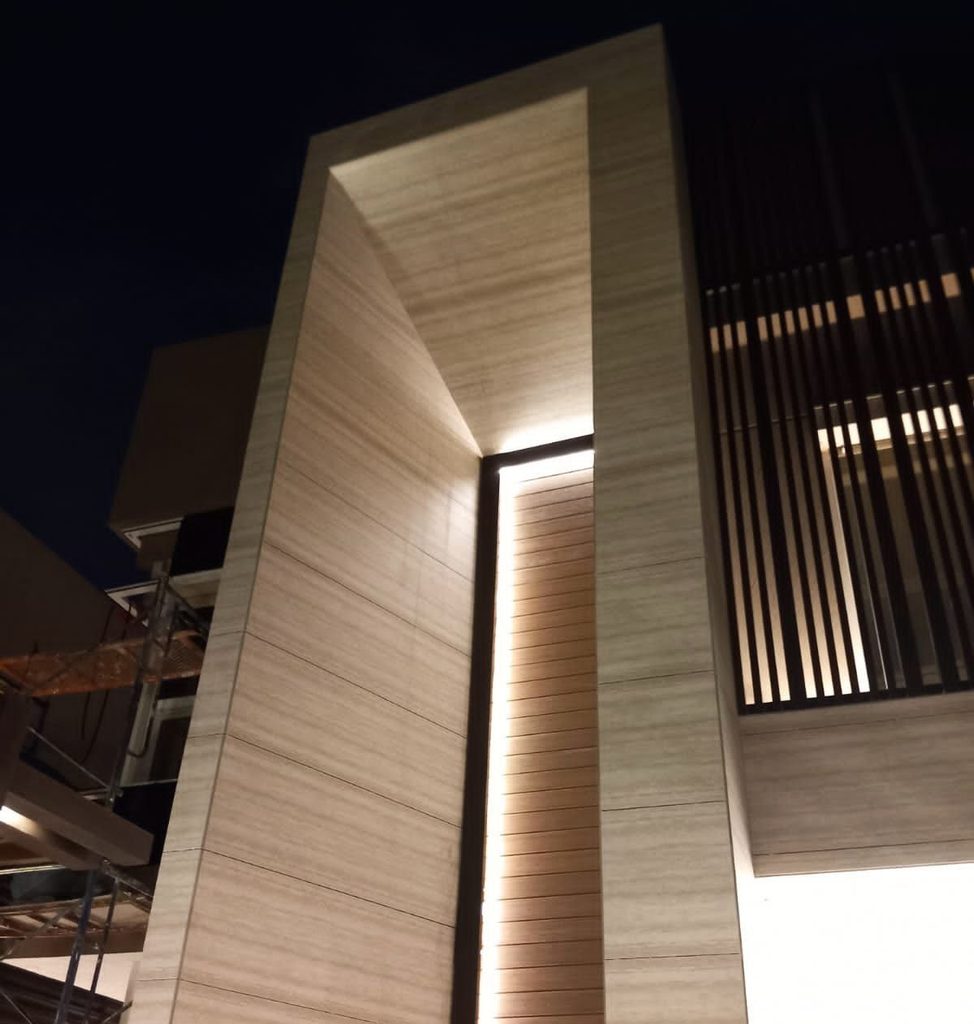
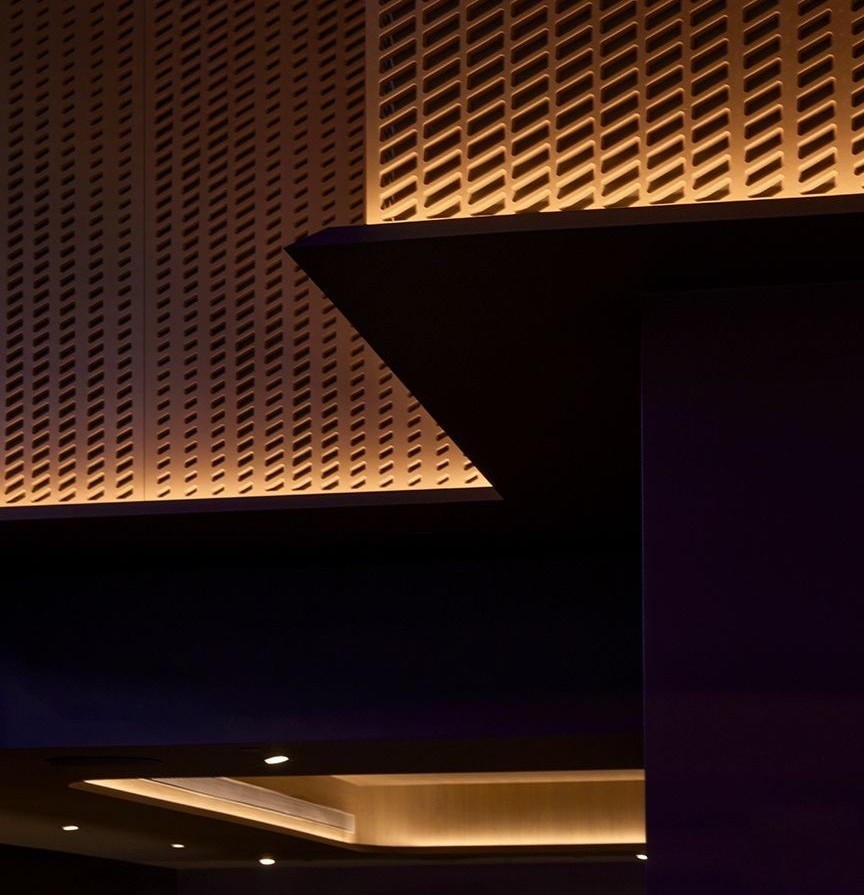
Grazing light approaches a surface at a shallow angle, creating small shadows that reveal its texture and depth.
This technique is especially effective on natural stone, textured plaster, brick, decorative concrete, and other materials with visible relief.
The shadows make raised and recessed areas easier to distinguish.
However, grazing light can also reveal imperfections. Uneven joints, surface marks, and inconsistent finishes may become more visible than they appear under daylight or broad illumination.
For that reason, the lighting design should consider the actual material sample before specifying the fixtures.
Light Color and Contrast
Color temperature influences how the facade materials appear. Warmer white light may complement warm-toned stone and timber, while a more neutral white may suit certain concrete or contemporary finishes.
These are starting points, not universal rules. The final choice depends on the material’s color, reflectance, surrounding lighting, and the architectural concept.
Contrast matters just as much as color.
When every part of a facade receives the same emphasis, decorative features can disappear into the overall brightness. A more deliberate hierarchy allows entrances, columns, recesses, and focal points to stand out.
Glare and Light Spill
A fixture may illuminate the intended wall while also sending light into a neighbor’s window, a driver’s field of view, or the night sky.
This is why shielding, accurate aiming, suitable optics, and appropriate mounting positions are essential parts of exterior lighting design.
Responsible outdoor-lighting guidance from DarkSky International also emphasizes using light only when needed, directing it where required, keeping levels no brighter than necessary, and choosing warmer light where practical.
The objective is to make the architecture visible without creating unnecessary glare or environmental disturbance.
Where the Light Comes From?
Facade lights can be mounted in the ground, attached to the building, concealed within architectural details, or positioned farther away on suitable mounting structures.
Each arrangement creates a different effect. Ground-recessed uplights can reveal surface textures, while wall-mounted fixtures can produce controlled upward or downward illumination.
The right position also depends on maintenance access, drainage, mounting conditions, and the ability to aim the light precisely.
These details should be considered before paving, landscaping, or exterior finishes are completed.


ARCHITECTURAL FACADE LIGHTING IN DUBAI AND ABU DHABI
Architectural facade lighting works best when it follows the logic of the building.
Instead of treating the exterior as a flat surface, the designer considers its proportions, recesses, projections, materials, and major architectural lines.
This approach produces a more coherent result because the lighting reinforces features that already belong to the architecture.
Columns, Cornices, and Recessed Entrances
Columns, cornices, entrance portals, and other architectural elements can help establish the visual rhythm of a facade.
Carefully positioned accent lighting can emphasize these details without illuminating every nearby surface equally.
The spacing and direction of the fixtures should correspond to the architectural geometry.
For a villa with a recessed entrance, for example, lighting the inner wall and doorway may create a welcoming focal point while keeping the broader exterior relatively understated.
Stone, Timber, and Textured Finishes
Different materials respond differently to the direction and quality of light.
Smooth surfaces may reveal gradients and reflections, while textured materials produce shadows that emphasize their physical character.
Natural stone can look striking under controlled grazing light, but excessive intensity may create a harsh or uneven appearance.
Timber may benefit from a warmer light color, although the actual result depends on the wood species and finish.
Whenever the finish is a central part of the architectural concept, reviewing a sample under the proposed lighting can help confirm the intended appearance.
Glass and Transparent Facades Carefully
Glass presents a different challenge. It transmits and reflects light, which means illuminating the glass itself may not create the desired visual effect.
In some situations, it is more effective to reveal the structural frame or to allow a controlled interior lighting scheme to establish depth behind the glazing.
The correct approach depends on the facade construction and what should be visible from outside.
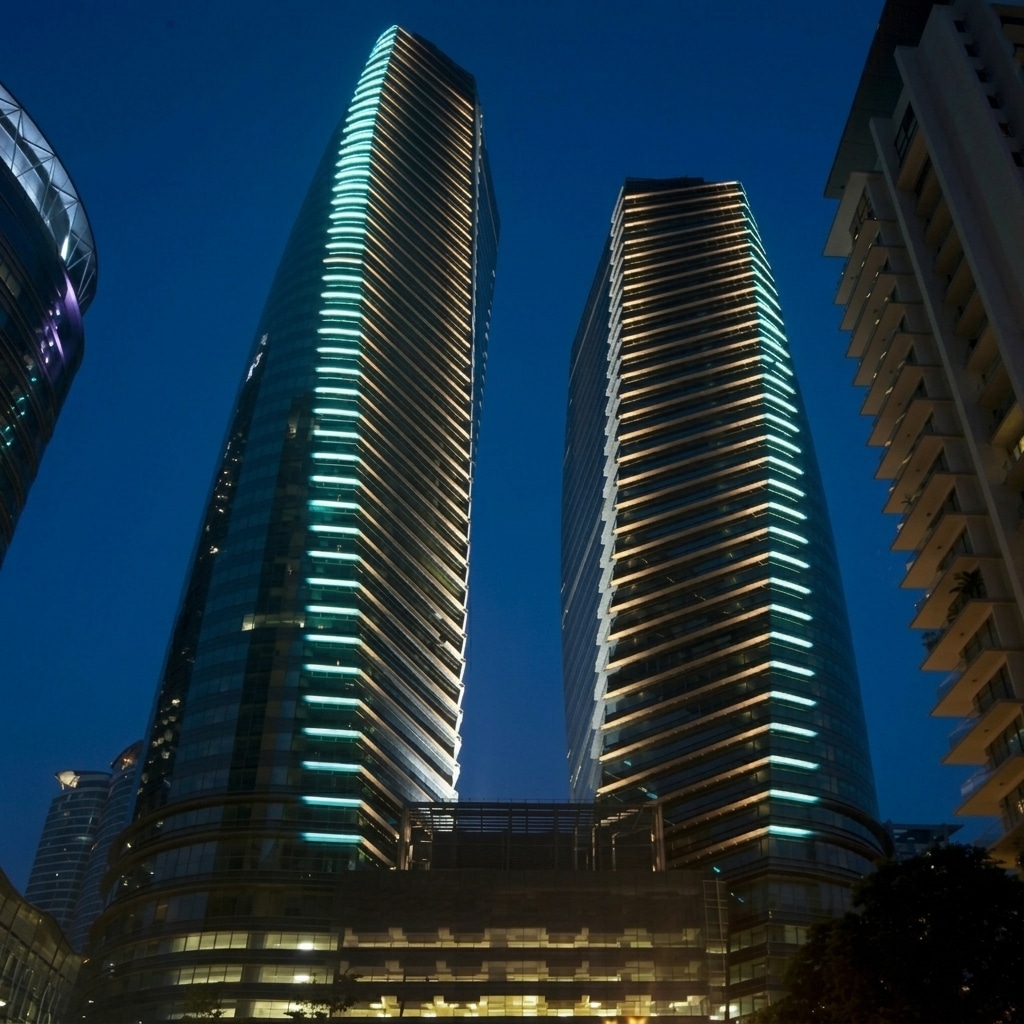
We clearly can itniess this when working on skyscraper facade lighting in UAE.
The design should also consider reflections from nearby luminaires, landscape lights, and bright interior surfaces.


LUXURY VILLA EXTERIOR LIGHTING DESIGN
A luxury villa’s exterior is experienced as a sequence of spaces rather than a single facade.
Visitors may approach through a driveway, pass through an entrance gate, walk toward the front door, and then move through a landscaped garden or covered outdoor seating area.
Lighting should help connect these spaces while giving the building a clear visual identity.
Lighting the Entrance and Main Approach
The entrance should be easy to recognize without becoming unnecessarily bright.
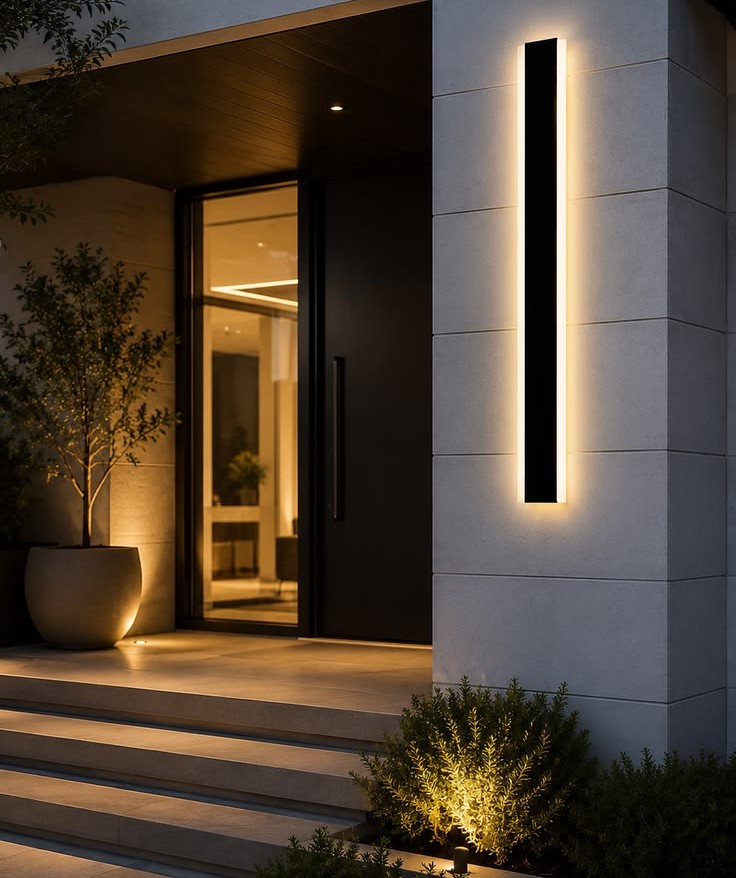
Architectural lighting can emphasize the doorway, reveal the surrounding materials, and help visitors understand the route to the front door.
Where the villa has a large canopy or recessed portal, concealed or carefully aimed fixtures may emphasize the depth of the entrance.
Wall-mounted lights can also provide useful illumination while contributing to the design.
The layout should be assessed from the street, the driveway, and the pedestrian approach. A fixture that looks attractive from one viewpoint may create glare from another.
Using Contrast to Establish a Visual Hierarchy
Not every part of the villa needs the same level of emphasis.
The main entrance might receive more visual attention than a secondary elevation, while a distinctive column or feature wall may become a smaller focal point.
This hierarchy gives the exterior a more intentional appearance. It also helps avoid the common mistake of trying to illuminate every surface with the same intensity.
The architecture should remain recognizable, with light supporting its strongest features rather than competing with them.
Balancing Luxury and Restraint
Luxury does not necessarily mean brighter lighting or a larger number of fixtures. In many cases, restraint makes architectural details more visible.
A controlled wash across a stone wall, a subtle line of light beneath a canopy, or a few carefully positioned uplights may communicate the design more clearly than a facade filled with competing beams.
The best solution is the one that reveals the building’s character and creates a comfortable visual experience.

LANDSCAPE LIGHTING DESIGN DUBAI
Landscape lighting is an important part of the exterior scheme because the building rarely exists in isolation.
Trees, planting, pathways, boundary walls, terraces, and outdoor seating all influence how the villa is perceived at night.
In Dubai, Abu Dhabi, and other UAE locations, landscape lighting should also respond to the actual site conditions, including irrigation, dust, heat exposure, and the layout of outdoor living areas.
Lighting Trees and Planting
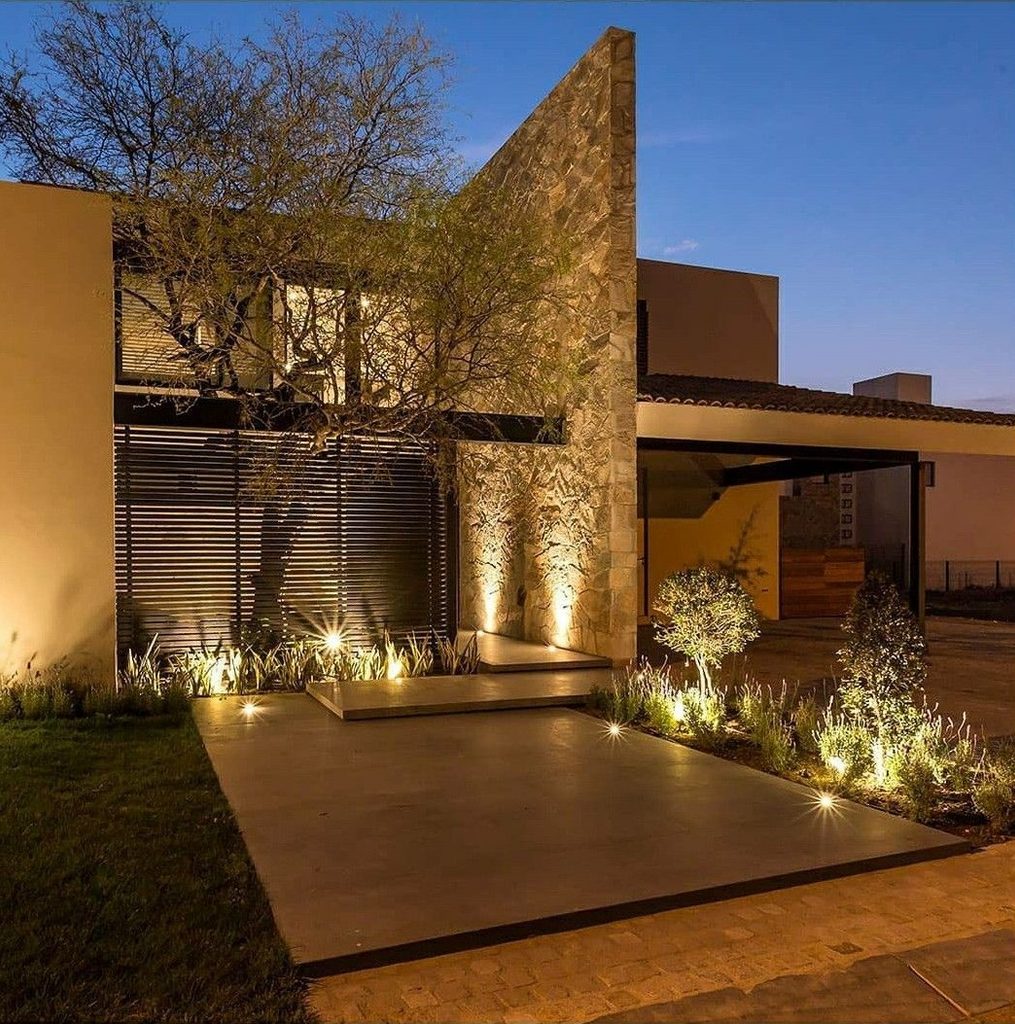
Trees can be highlighted from below or from carefully selected positions around their canopies.
The right method depends on the tree’s shape, size, foliage density, and role in the landscape.
A narrow beam uplight can emphasize a trunk or a particular branch structure, while a wider distribution may illuminate a broader canopy.
Multiple fixtures should be aimed carefully so that their combined output does not create excessive brightness or unnecessary spill.
Not every tree needs lighting. Selecting a few meaningful features can create a clearer composition and reduce the number of fixtures required.
Boundary Walls and Garden Architecture
Boundary walls, decorative screens, water features, and garden structures can help define the property after dark.
Wallwashing can create a relatively even appearance, while grazing light can reveal texture in stonework, textured render, or decorative blocks.
Patterned screens may also cast shadows, although those patterns need to be positioned and controlled carefully.
The designer should consider views from both inside and outside the property, particularly where garden lighting is visible through large windows.
Pathways and Outdoor Circulation
Path lighting should support safe movement while preserving the intended atmosphere.
Fixtures can illuminate steps, changes in level, entrances, and route junctions without making the entire garden uniformly bright.
Their positions should avoid creating direct glare for pedestrians. Shielded fixtures and controlled output can provide useful illumination while limiting unwanted light above or beyond the path.
The layout should also coordinate with planting growth, irrigation systems, paving joints, and future maintenance access.

POOL AND GARDEN LIGHTING DESIGN
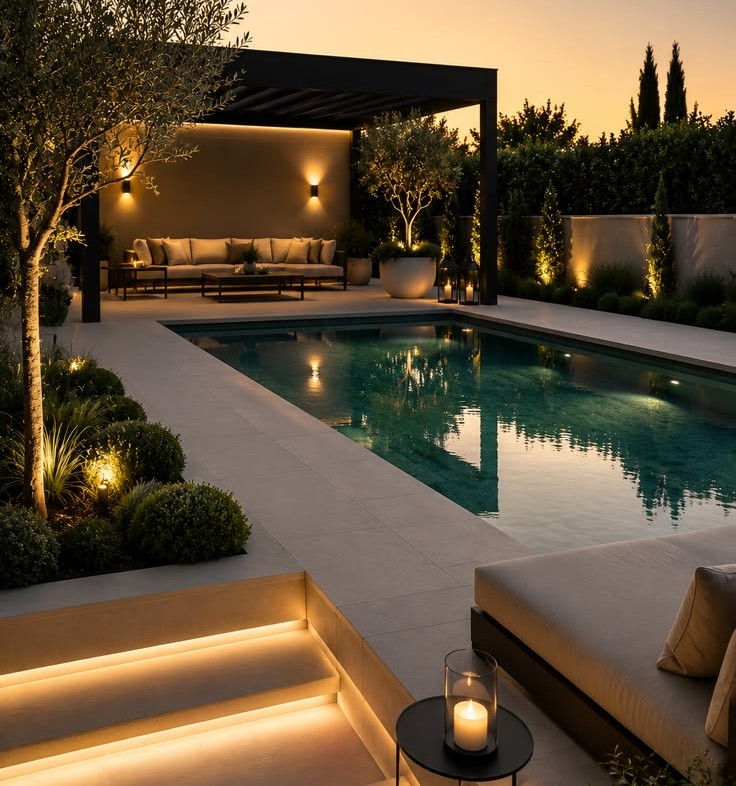
Pools and gardens often become central features of a luxury villa in the evening. Yet lighting these spaces requires more than selecting visually attractive fixtures.
The design must balance the desired atmosphere with safe movement, environmental protection, appropriate electrical installation, and control of glare and reflections.
Lighting Around Swimming Pools
Pool areas contain reflective water surfaces and transitions between wet and dry zones.
A light that appears comfortable when viewed from the deck may produce an intense reflection from the water when viewed from inside the house.
The designer should consider beam direction, mounting height, reflection angles, and the visibility of surrounding steps and circulation routes.
Products must be selected for the actual installation environment. Underwater luminaires, nearby exterior fittings, and electrical accessories have different installation conditions and must meet the relevant requirements for their location.
Integrating the Pool With the Architecture
A pool often reflects the villa, landscape, and surrounding lighting.
If the facade, garden, and pool are designed separately, their combined reflections can create too many competing visual elements.
A coordinated plan considers the relationship between the illuminated building and its reflection in the water.
This may mean keeping some surfaces softly lit while giving a smaller number of features stronger emphasis.
The intention is to make the pool feel connected to the architecture, not like a separate lighting display.
Garden Seating and Outdoor Dining
Outdoor dining areas need enough light for food, tableware, and movement, while seating areas often benefit from softer illumination.
The designer can combine discreet architectural fixtures with selected landscape lights to give these areas a distinct character.
Controls allow different scenes to be used for dining, entertaining, or quieter evenings.
The appropriate approach of outdoor lighting design depends on how the homeowner uses the outdoor space and how much light enters the surrounding property.

OUTDOOR LIGHTING DESIGN FOR VILLAS
The performance of an outdoor lighting scheme depends heavily on product selection.
A fixture that looks correct in a product photograph may be unsuitable for the intended mounting position, beam direction, or exposure conditions.
Technical specifications help the designer determine whether each product is appropriate for the job.
Beam Angles and Optical Distribution
A beam angle describes the spread of light emitted by a luminaire, but the published angle alone does not completely describe its performance.
The optical distribution, luminous intensity, aiming direction, distance to the surface, and mounting height also affect the final result.
Manufacturer photometric files can help designers evaluate these factors through lighting calculations.
Narrow, medium, and wide distributions serve different purposes.
They should be selected based on the facade dimensions and intended effect rather than using the same fixture type throughout the property.
IP Ratings and Environmental Exposure
Outdoor fixtures must be appropriate for the conditions in which they will operate.
Dust, water, irrigation, direct weather exposure, and installation near the ground can influence the required protection and construction.
The Ingress Protection (IP) rating indicates protection against the entry of solids and water under specified test conditions.
It does not, by itself, guarantee suitability for every outdoor environment.
The designer should review the exact product documentation, mounting method, cable entries, and light installation instructions.
Corrosion resistance, temperature limitations, mechanical protection, and drainage may also be relevant.
Maintenance and Access
Some facade luminaires are positioned high on the building, concealed within architectural details, or installed close to paving.
Their maintenance requirements should be understood before the locations are finalized.
The project should establish how fixtures can be inspected, cleaned, repaired, and replaced.
Drivers and connections may also need accessible locations, depending on the product and installation design.
A suitable product is not only one that creates the intended visual effect.
It should also be practical to maintain throughout its service life.
FACADE LIGHTING DESIGN DUBAI
Facade lighting design in Dubai should be developed with the applicable building requirements and the physical conditions of the site in mind.
Design decisions should not be made solely from visual references or assumptions about what is permitted.
The requirements for Dubai and Abu Dhabi may differ, so the team should confirm the applicable rules with the relevant authority for the specific project.
Exterior Lighting Power and Controls
The Dubai Building Code 2021 includes provisions on exterior lighting power, shielding, light pollution, and automatic controls.
It sets a maximum average exterior connected lighting power density for the covered building-envelope applications and includes requirements intended to direct light appropriately.
The code also specifies that wallwashing lights should spill no more than 10% of the lighting past the building facade under the relevant provisions.
Applicable requirements should be checked against the current approved code and the project’s scope rather than assumed to apply identically to every location or installation.
For villa projects, the code also addresses exterior lighting pollution and control of exterior lighting during daylight hours.
Lighting design for large residential projects in Dubai often includes facade lighting by default.
Avoiding Light Trespass
Light trespass occurs when light reaches an area where it is not intended or wanted, such as a neighboring home or bedroom window.
The design should consider the property’s boundaries, mounting heights, beam directions, and likely viewing angles.
Shielding and accurate aiming can reduce spill while maintaining useful illumination on the intended surface.
This is particularly important for villas in residential communities where neighboring properties may be close to boundary walls and gardens.
Coordination Before Construction
Lighting positions should be coordinated with architectural drawings, exterior finishes, waterproofing details, landscape plans, and electrical routes.
For example, a ground-recessed uplight needs suitable installation conditions, while a wall-mounted fixture may need its cable route and fixing details resolved before the finish is completed.
Early coordination helps reduce the likelihood of cutting finished surfaces, relocating fittings, or introducing visible wiring that was not part of the design.
FACADE LIGHTING DESIGN CONCEPTS
There is no single style of facade lighting that suits every villa.
Some properties benefit from a quiet, consistent treatment of the main surfaces, while others call for stronger emphasis on architectural details or carefully controlled color effects.
The concept should be selected according to the building’s form, materials, surroundings, and the homeowner’s preferences.
Minimalist Wallwashing
Wallwashing creates a relatively uniform layer of light over a facade. It can make the building feel calm and composed, particularly when the architecture relies on broad surfaces and simple geometry.
The success of the technique depends on fixture spacing, wall distance, optical design, and the dimensions of the surface.
Wallwashers should be selected and arranged using manufacturer guidance and, where appropriate, photometric calculations.
Grazing Light for Textured Architecture
Grazing light is particularly suitable when the texture of a material is an important part of the design.
The light should strike the surface at a shallow angle to emphasize its relief.
The mounting position and optical distribution need to be considered together, since an unsuitable arrangement can create unwanted bright patches or uneven gradients.
A sample installation can be valuable for stone cladding or decorative surfaces whose appearance changes significantly under directional light.
Architectural Accents and Controlled Color
Accent lighting can emphasize columns, entrance recesses, screens, and other prominent features.
The distribution should follow the architecture so that the light appears intentional rather than randomly scattered across the facade.
Color-changing or RGBW systems may be suitable for selected properties where dynamic effects are an explicit design objective.
However, they are not automatically appropriate for every luxury residence.
Where architectural materials and timeless appearance are the main priorities, a carefully selected white-light scheme may remain more suitable.
Any dynamic effects should be controlled to preserve the overall character of the building and avoid unnecessary disturbance beyond the property.
Testing the Concept Before Installation
Renderings and lighting calculations can help the designer assess the proposed arrangement, but they serve different purposes.
A rendering communicates the intended visual appearance, while a photometric calculation evaluates light distribution using the selected product data and model assumptions.
For a high-value villa, a nighttime sample or mock-up can help confirm how the actual facade material responds to the proposed beam and color temperature.
This is often more useful than approving products from catalog images alone.
HOUSE FACADE LIGHTING DESIGN: COMMON MISTAKES
A good facade lighting scheme should make the architecture easier to appreciate.
Certain common mistakes can work against that goal, even when the specified fixtures are technically capable of producing enough light.
Using Too Many Fixtures
Adding more fixtures does not necessarily produce a better result. Too many overlapping beams can create visual clutter and make architectural details compete for attention.
A better starting point is to identify the main features that deserve emphasis and work backward from those priorities. A smaller number of carefully positioned luminaires may produce a clearer visual hierarchy.
Ignoring Surface Reflectance and Texture
The same luminaire can produce very different results on dark stone, pale plaster, polished metal, and textured concrete.
A surface with high reflectance may appear brighter than expected, while a darker finish may require a different approach to produce the intended visual effect.
Texture can amplify shadows, making the position of the light source especially important.
The designer should consider the actual material and its finish when preparing the scheme.
Creating Glare and Uneven Brightness
An exterior fixture can be visually uncomfortable if its light source is exposed to pedestrian eye level or visible from common viewing positions.
Incorrect spacing can also create bright spots and dark gaps along the facade. Both issues can often be reduced through appropriate optics, mounting positions, shielding, and careful aiming.
The design should be reviewed from the viewpoints people are likely to experience, including the entrance, driveway, garden, and nearby windows.
Forgetting Controls and Maintenance
A facade lighting system should not need to operate at full output throughout every hour of the night.
Dimming, timers, and suitable automatic controls can help align the lighting with actual use.
The project also needs a practical maintenance plan. A fixture that is difficult to reach or repair may create avoidable costs later, especially when many identical luminaires are installed around the property.
FINAL THOUGHT
People choose facade lighting in Dubai and Abu Dhabi to change the way a luxury villa is experienced after sunset.
It can reveal the texture of stone, emphasize architectural proportions, establish a welcoming entrance, and connect the building with its garden and outdoor living spaces.
The strongest results usually come from restraint and precision. The designer identifies the features that matter, chooses light distributions that suit the materials, controls glare and spill, and coordinates the installation with the architecture.
For villa owners in Dubai and Abu Dhabi, that means thinking about lighting before the exterior finishes and landscaping are complete.
Product specifications, local requirements, mounting details, and maintenance access should all be considered as part of the same plan.
When these decisions are coordinated, the lighting does more than make the building visible.
It helps the architecture express its character, while keeping the surrounding environment comfortable and the finished installation practical to maintain.

Related Posts
Outdoor Lighting Design for Villas, Pools, and Landscapes in Dubai and Abu Dhabi
Skyscraper Facade Lighting in UAE: A Guide for CEOs, Contractors, and Architects


Wall Light Design in UAE for Homes & Villas
